On January 15, JTB (Japan Travel Bureau) announced its long-term vision “OPEN FRONTIER 2035,” looking ahead to the year 2035. Centered on four themes—”Global,” “Business Model,” “Information & Data,” and “Culture”—the company will pursue transformation and aim to create new value through “exchange” between people and regions.
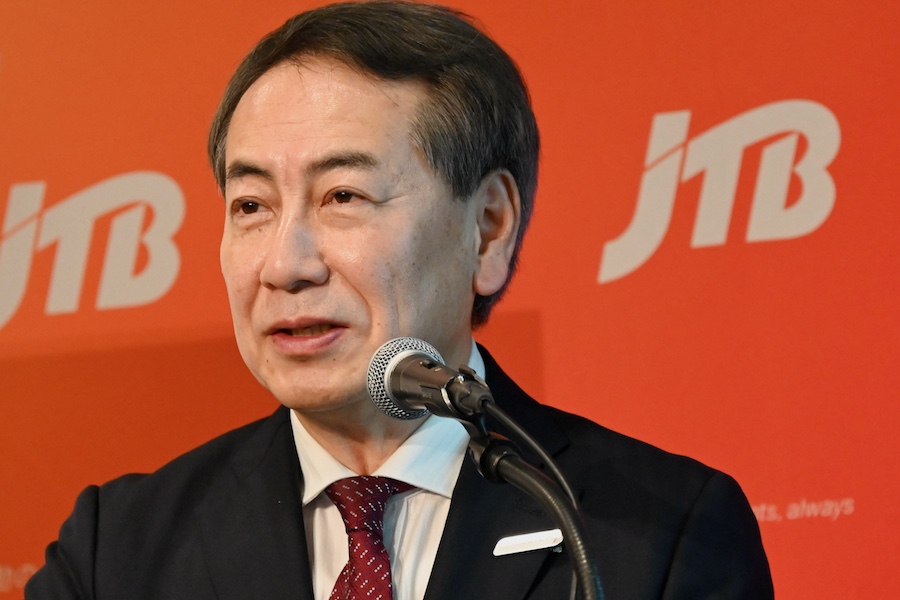
At a press conference held in Tokyo, President Eijiro Yamakita pointed out that, due to environmental change such as climate shifts, demographic changes, and the evolution of generative AI, “exchange” will play an important role in generating social value by 2035. Under the vision theme of “Exchange Creation Intelligence,” JTB defines its desired position in 2035 as “a frontier company in the new era of exchange that, through high expertise and insight, connects and creates the world, links it together, and fills people with inspiration and happiness.”
In its global strategy, JTB plans to increase the ratio of its global business in the overall business portfolio from 14% in 2024 to 50%. In August 2025, it will acquire U.S.-based Northstar Travel Group, the world’s largest media company in the travel industry. By leveraging Northstar’s global network, marketing solutions, and AI expertise, JTB intends to expand its lineup of digital products and strengthen services and solutions for customers.
In terms of its business model, the company will raise the ratio of recurring (stock-type) business from 11% in 2024 to 30% through investment in content and real estate. While maintaining its traditional transaction-based (flow-type) business as a foundation, JTB will shift its revenue model to a “flow + stock” hybrid. On January 14, it announced the establishment of Asobi JTB, a joint venture with Asobisystem, a company based in Harajuku that promotes Japan’s “KAWAII” culture. The new company will develop food & beverage businesses and events for international visitors to Japan, aiming to cultivate overseas markets in the fields of entertainment and content.
Regarding its information and data strategy, President Yamakita stated that “it cannot be discussed without AI” and expressed his intention to combine data from approximately 20 million JTB Travel Members with an AI-based information platform in order to analyze customer insights.
On the cultural side, JTB will promote DEIB (Diversity, Equity, Inclusion, and Belonging). Through programs such as the “Future Tourism School” for working adults and university students, the “PMY Academy”—a social experiential learning platform for junior and senior high school students—and the “Ryokan Management Human Resource Development Academy” for personnel in the Japanese inn and hotel industry, the company will foster human resources that support Japan’s travel and tourism industry.
President Yamakita also explained the expansion of JTB’s business strategy segments. In addition to its existing segments—”Global Tourist Solutions” for the individual customer market, “Global Business Solutions” for the corporate market, and “Global Area Solutions” for government entities, destination management organizations (DMOs), and tourism operators—the company will newly establish “Global Tourism Intelligence,” targeting all stakeholders in the tourism industry. Centered on Northstar and JTB Tourism Research & Consulting Co., JTB will provide marketing solutions through media and events, supporting the enhancement of added value for the industry as a whole.
Through these transformations, JTB is aiming in fiscal 2035 for a total transaction volume of 2.5 trillion yen (versus 1.6838 trillion yen in fiscal 2024), gross profit of 500 billion yen (versus 293.7 billion yen), and operating profit of 75 billion yen (versus 14.9 billion yen).
Notice
This article was generated using automatic translation by GPT-4 API. The translation may not be accurate.