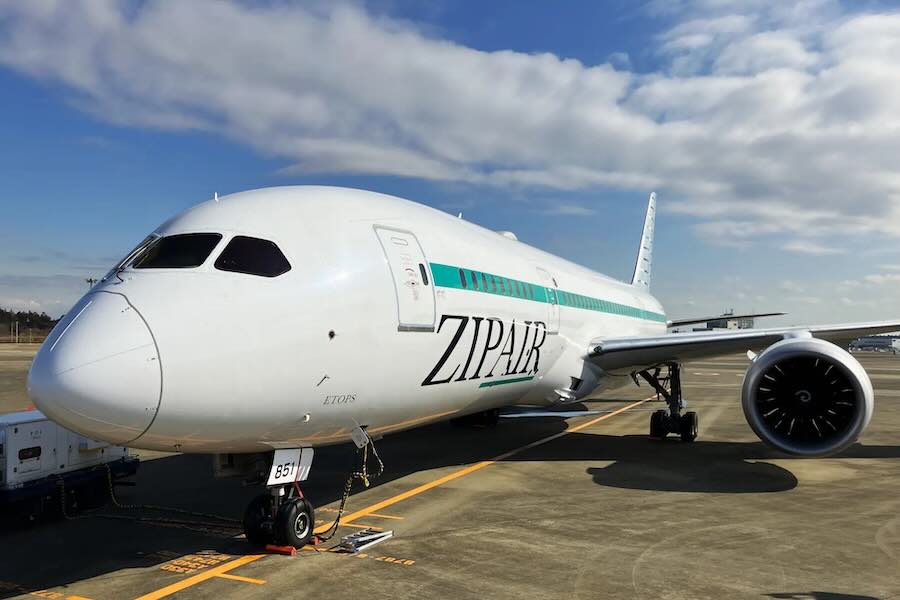
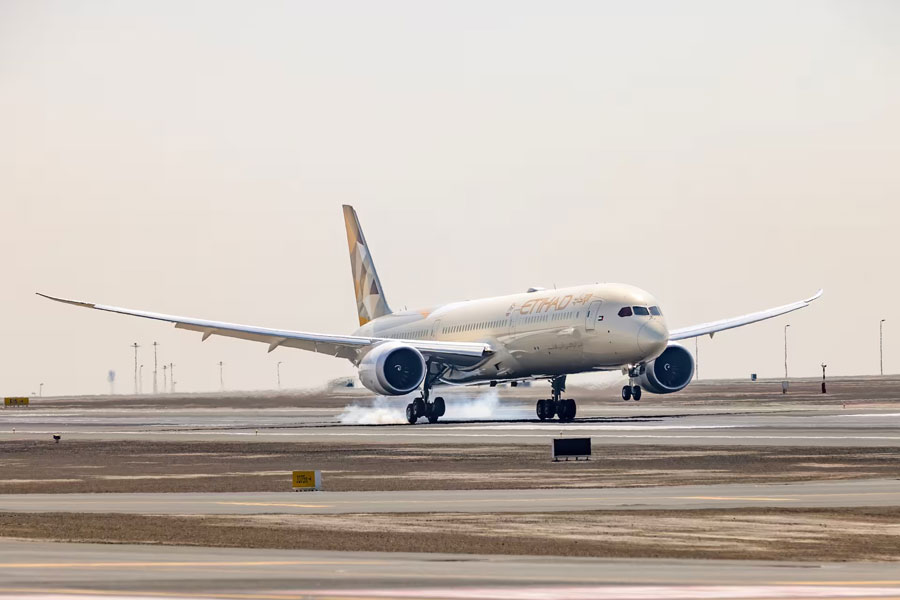
ZIPAIR Tokyo has been operating a Boeing 787-8 aircraft with a riblet-structured coating since January 27.
The coating was applied jointly by Japan Airlines (JAL), the Japan Aerospace Exploration Agency (JAXA), and O-Well. The target aircraft is one Boeing 787-8 (registration: JA851J). This is the first time riblet-structured coating has been applied to a ZIPAIR aircraft.
Riblets are a fine grooved structure inspired by shark skin, a technology that reduces aerodynamic drag during flight by arranging the grooves along the airflow on the aircraft surface. Using the Paint-to-Paint Method jointly developed by O-Well and JAXA, a fine grooved structure was formed on the sides of the aircraft fuselage. Compared to decal or film methods, this approach reduces weight and improves durability. By improving the pressing and positioning jigs for the riblet transfer sheets and carrying out the work in the JAL hangar at Narita Airport, they enhanced both quality and work efficiency, while also establishing a system that allows application not only at Haneda Airport but at Narita Airport as well.
Since January 18, 2025, JAL has been deploying an international-flight Boeing 787-9 (registration: JA868J) with riblet-structured coating applied to its fuselage. In November 2025, the coated area was expanded to the upper part of the fuselage. According to JAXA, this expansion increased the drag reduction rate during cruise from 0.24% to 0.31%, and when operating on the Narita–Frankfurt route for one year, it is expected to reduce fuel consumption by about 154 tons and carbon dioxide emissions by about 492 tons.