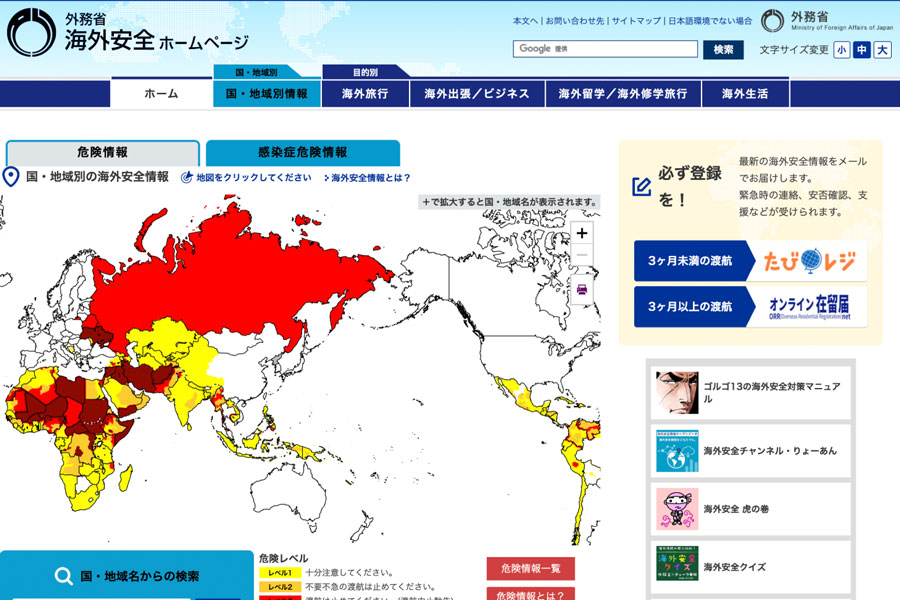
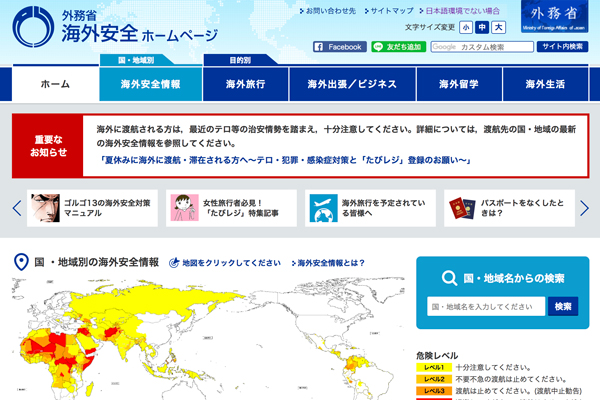
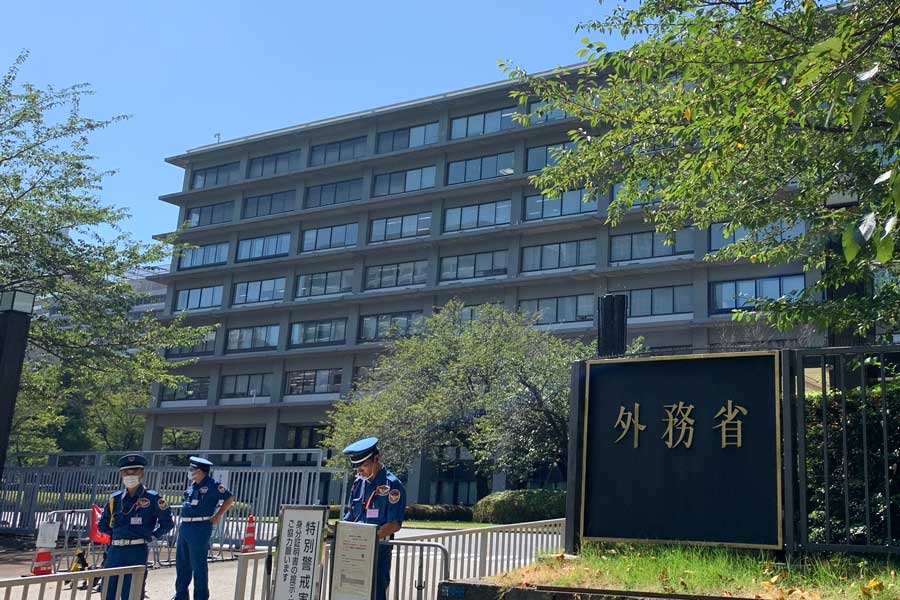
Japan’s Ministry of Foreign Affairs has updated its risk information for Cuba, raising the risk level for areas that previously had no travel advisory.
For all regions of Cuba other than Habana Vieja (Old Havana) and Centro Habana (central urban district), which until now had no travel advisory, the risk level has been raised to Level 1 (Exercise caution). As a result, the entire country of Cuba is now at Level 1.
Cuba is currently facing a severe shortage of fuel and energy, and prolonged power outages are frequently occurring throughout the country. Even in the capital city of Havana, long blackouts lasting 15 to more than 20 hours a day continue, and the impact of resulting water supply cuts has become serious. This has had a major effect on the provision of basic services such as transportation, medical care, and telecommunications, and measures such as reduced operating hours at public institutions have been implemented. It is said that in towns and cities it is almost impossible for foreign nationals to obtain medicines. Some airlines have been repeatedly changing flight routes and reducing or cancelling flights.
In terms of public safety, overall security is deteriorating in line with the domestic economic situation. In particular, in Habana Vieja and Centro Habana, a series of robberies and robbery-assault cases have occurred, and Japanese nationals have also been victimized. While most incidents had previously occurred at night, they have recently been taking place during the daytime as well.
With respect to payments, in addition to the ongoing inability to use cards issued by U.S.-based companies, the handling of VISA and Mastercard was suspended in June. Many cases have been reported in which travelers assume that credit cards can be used and therefore bring only a small amount of cash, leaving them in financial difficulty. Since it is practically impossible to remit foreign currency to Cuba via financial institutions or foreign remittance services, it is extremely difficult to receive money transfers from Japan even if a traveler suffers from illness, injury, theft, or other damage.
The Ministry of Foreign Affairs urges those visiting Cuba to gather sufficient information in advance and to bring enough cash (mainly U.S. dollars or euros) so as not to run short until departure. At the same time, it notes that mosquito‑borne infectious diseases such as dengue fever, Zika virus infection, Oropouche fever, and chikungunya fever are prevalent, and advises travelers to use insect repellent and avoid exposing skin.
Notice
This article was generated using automatic translation by GPT-4 API. The translation may not be accurate.