As extreme weather events such as lightning and torrential rain become more severe and frequent, the Japan Airlines (JAL) Group is strengthening its countermeasures. At Tokyo/Haneda Airport, it has introduced towable trailer houses as evacuation shelters for ground handling staff. They are used as cooling spaces to prevent heatstroke under normal conditions and as emergency shelters during thunderstorms. On the operational side, JAL is using Lilac, an AI-based lightning-strike avoidance prediction system, to enhance safety and operational reliability both in the air and on the ground.
“Evacuation Trailers” Protect Ground Staff from Lightning and Extreme Heat
At Tokyo/Haneda Airport, a three-level alert system is used according to approaching lightning conditions. A “Thunderstorm Warning” is issued when thunderclouds are observed within approximately 50 kilometers of the airport and may approach. A “Thunderstorm Warning Condition 1” is issued when thunderclouds are observed within approximately 20 kilometers, or when thunder or lightning is confirmed. A “Thunderstorm Warning Condition 2” is issued when thunderclouds approach within approximately 8 kilometers, or when thunder or lightning is confirmed near the airport.
When Condition 2 is declared, all work related to aircraft arrivals and departures in the ramp area is suspended, and ground workers are instructed to take shelter inside aircraft, facilities, or vehicles. However, because the ramp area is extensive, work locations are often far from buildings, making it a challenge to secure places where staff can quickly shelter when thunderclouds suddenly approach.
In addition, ramp areas in summer offer few places to escape intense sunlight, and there are limited places where workers can cool down while waiting for aircraft to arrive. With recent extreme heat, heatstroke prevention has also become a major issue.
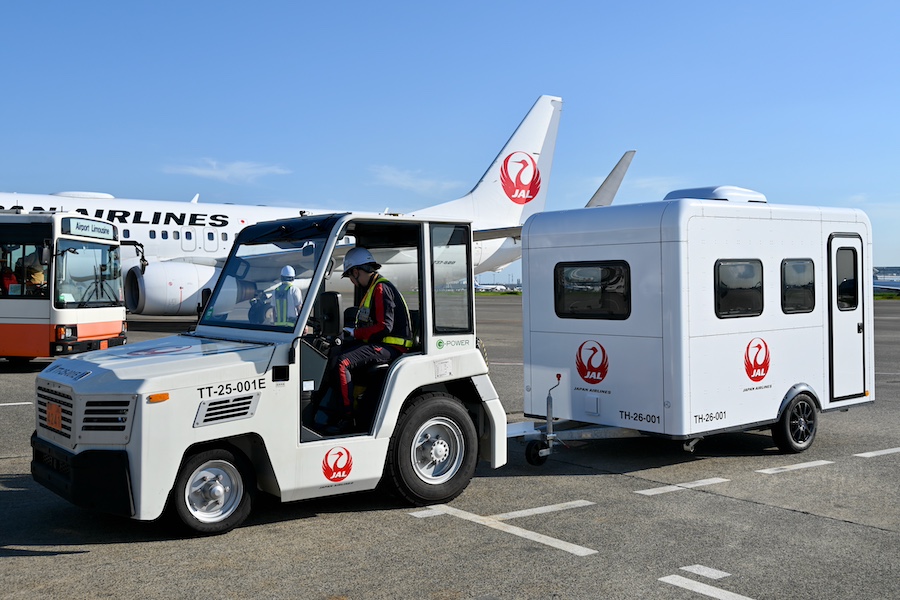
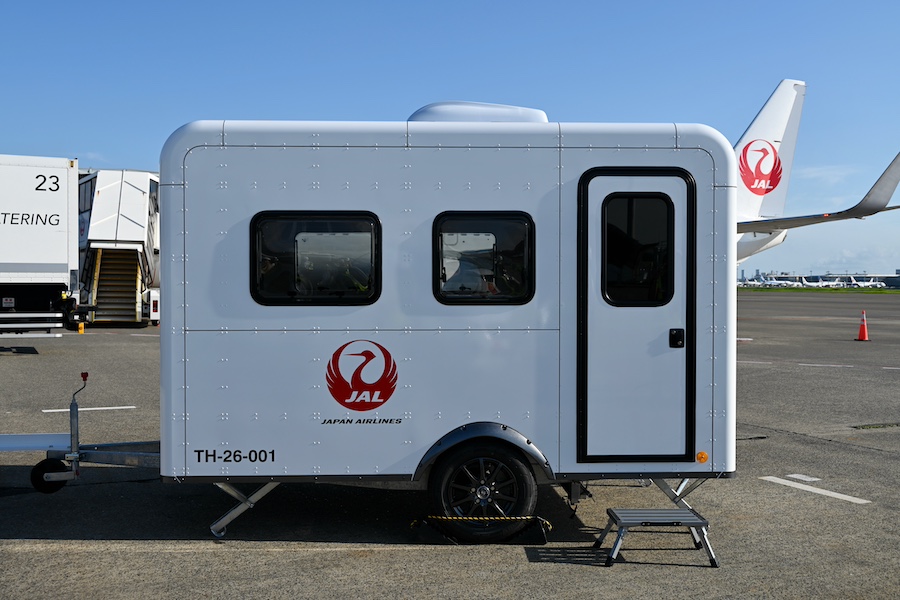
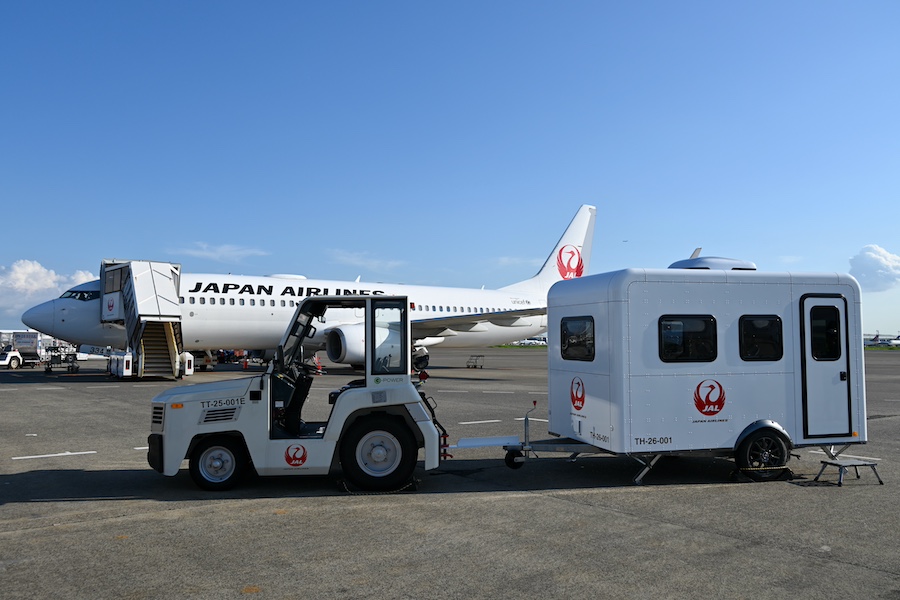
On August 13, the JAL Group introduced a towable “evacuation trailer house” at Tokyo/Haneda Airport. It is primarily positioned near aircraft parking stands away from the terminal, serving as a rest area and cooling space under normal conditions and as an emergency shelter during thunderstorms.
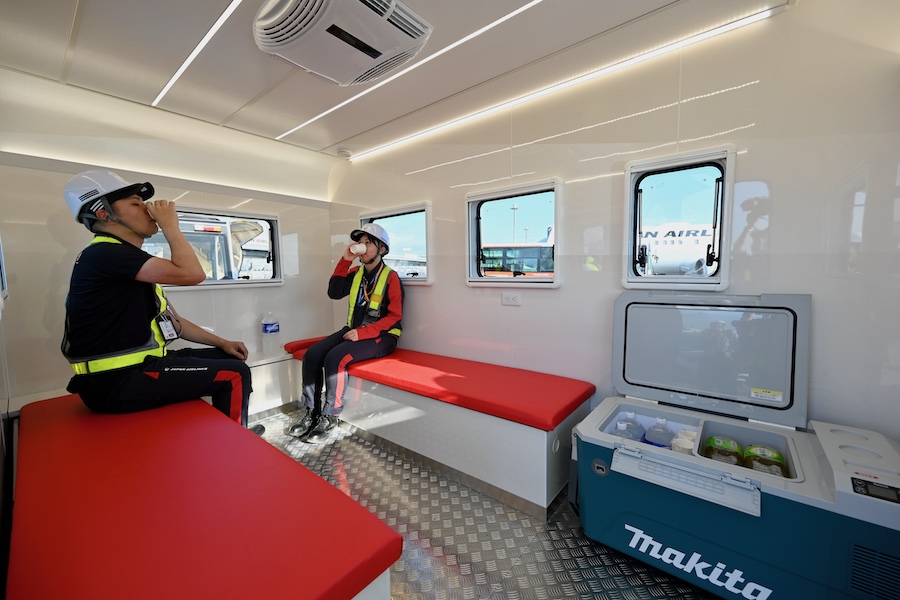
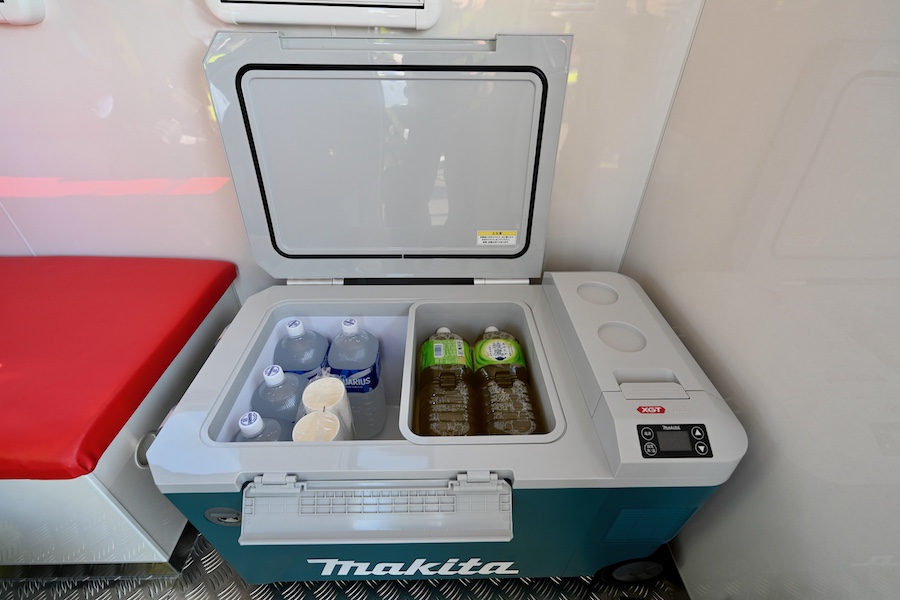
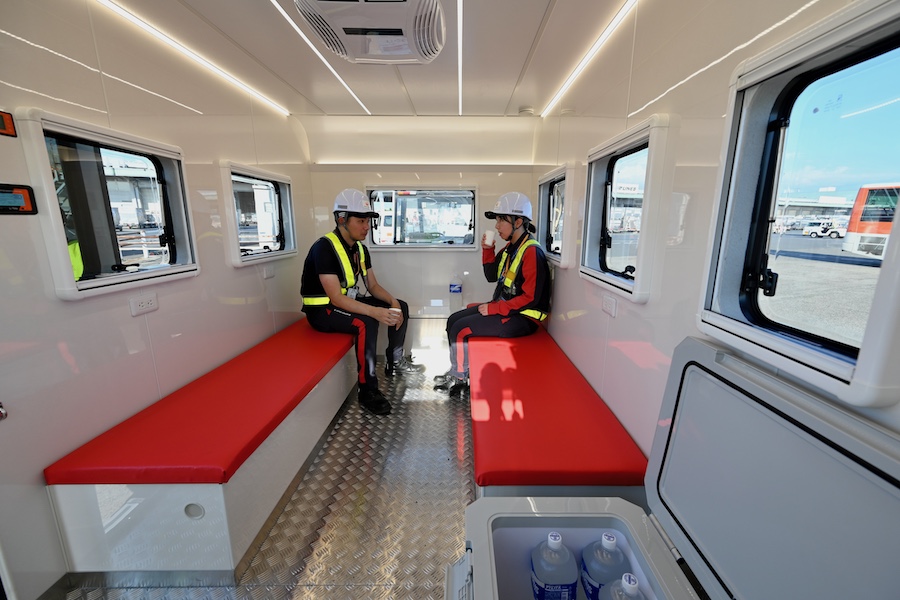
The trailer measures 4.56 meters long, 1.96 meters wide, and 2.39 meters high. Inside are bench seats, air conditioning, a refrigerator, and charging outlets. Designed for workers entering while wearing rain gear, it has waterproof flooring and a drain. It is intended to accommodate six to eight people under normal conditions and approximately 10 people in an emergency.
Its power system uses a 13.4-kilowatt-hour lithium-ion battery and solar power. The air conditioner can run continuously for up to around 10 hours on the battery alone, while energy-saving mode enables cooling for approximately 24 hours. After use, it can be connected to existing charging equipment and fully recharged in about eight hours.
Yu Ichimura, manager of the Planning Group in the BPR Promotion Office of JAL Ground Handling’s Planning Department, which oversaw the introduction, explained that the trailers can be used year-round: to address heatstroke and lightning in summer, and as places to keep warm in winter.
On the first day of deployment, Condition 2 was actually issued and ground workers took shelter inside the trailer. According to Ichimura, staff who used it praised the cool interior and the reassurance of having a shelter close to their work area.
JAL will first deploy one unit at Tokyo/Haneda Airport to evaluate operating time, usability, and comfort, with a view to full-scale introduction from 2027. From June 2027 onward, deployment is planned at Osaka/Itami, Tokyo/Narita, and Fukuoka airports, while introduction at Sapporo/Chitose is also under consideration.
AI Predicts “Triggered Lightning,” Helping Aircraft Avoid Lightning Strikes Aloft
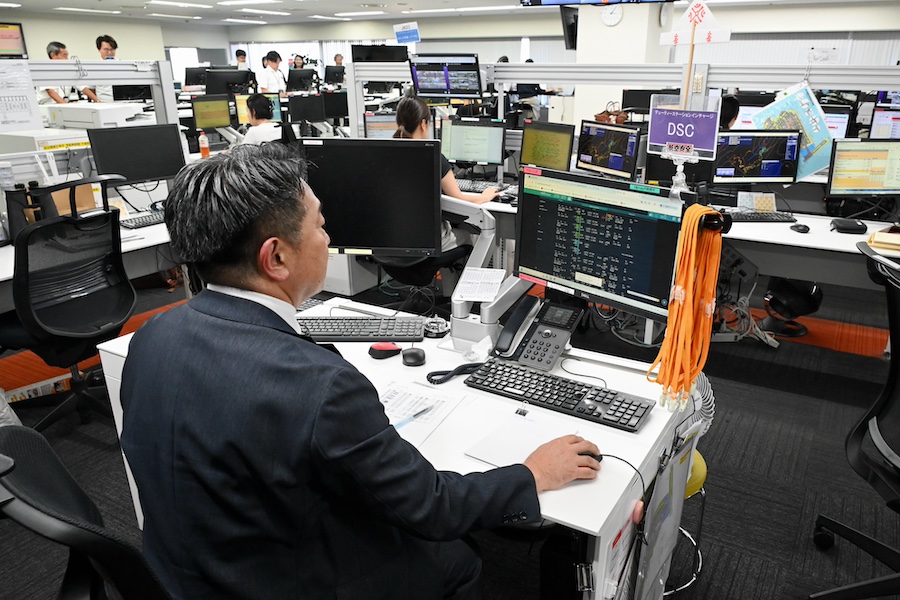
Meanwhile, on the operational side, JAL is advancing efforts to use AI to avoid lightning strikes on aircraft.
When an aircraft is struck by lightning in flight, it must be inspected after arrival. If damage is found, repairs or arrangements for a replacement aircraft are required. This can lead to delays or cancellations. Repairs are particularly likely to be extensive on aircraft that make extensive use of carbon-fiber-reinforced polymer (CFRP), including the Boeing 787 and Airbus A350. JAL says it incurs annual losses amounting to several hundred million yen, including repair costs and lost revenue while aircraft are out of service due to lightning strikes.
Lilac, which began operation in fiscal 2024, predicts the risk of “triggered lightning,” caused when an aircraft enters an area where lightning is highly likely to occur. Even in cases where conventional weather radar only shows weak snow or rain clouds, Lilac can identify areas with a high likelihood of lightning strikes in advance.
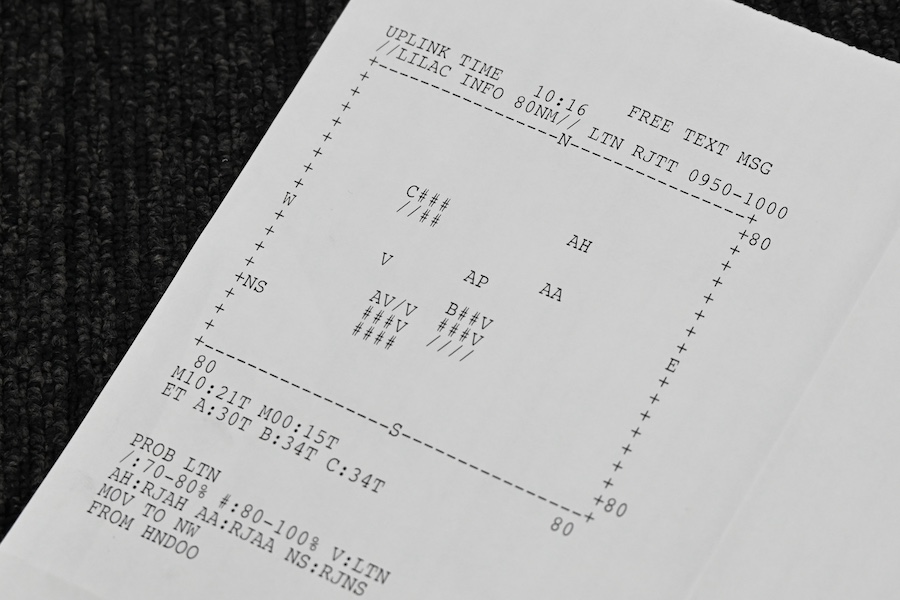
The predicted lightning-strike risk is converted into “ASCII ART,” which uses combinations of characters to create a visual representation, and transmitted to aircraft. Pilots combine this information with onboard weather radar and visual observations, changing course as necessary to avoid high-risk areas.
▲ASCII art showing lightning-strike risk
In winter, snow clouds that appear weak as thunderclouds can still carry a high risk of triggered lightning. Around Niigata on January 15, 2026, Lilac detected lightning-strike potential of 70% to 80% or higher over a wider area than the area displayed strongly on rain and snow radar.
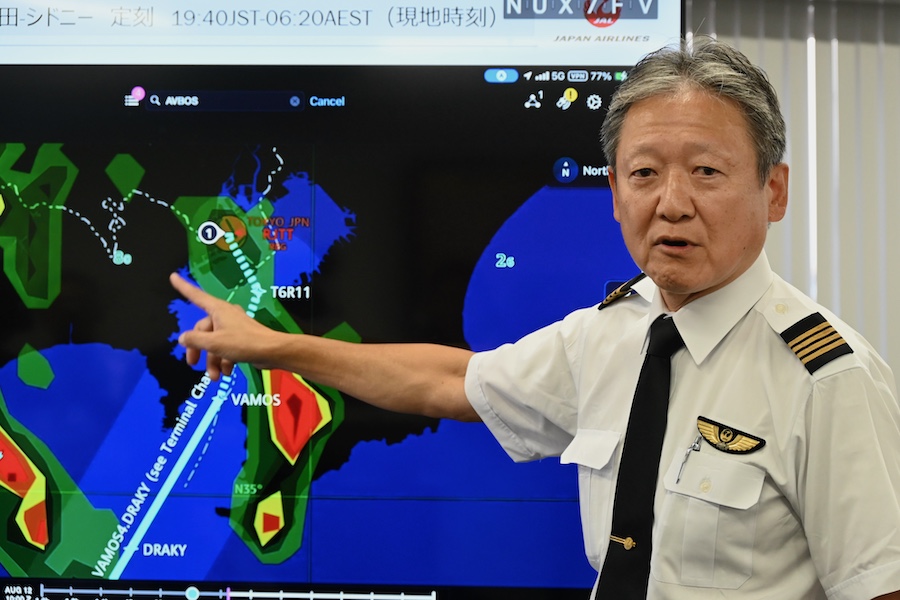
The system is also being used for avoidance in actual operations. On JAL Flight JL51 from Tokyo/Haneda to Sydney on August 12, operated by a Boeing 787, cumulonimbus clouds with high lightning-strike potential were identified before departure. The aircraft changed course soon after takeoff and flew around the area.
▲Captain Masayuki Miyata, who operated Flight JL51 on August 12
Since Lilac began operation, the number of lightning strikes affecting JAL and Japan Air Commuter (JAC) aircraft has trended downward. The figure fell from 75 in fiscal 2023 to 56 in fiscal 2024 and 43 in fiscal 2025, representing year-on-year declines of 25.3% and 23.2%, respectively. The number of maintenance cases also decreased from 178 in fiscal 2024 to 96 in fiscal 2025. For Boeing 787 aircraft in particular, the number fell from 71 to 28.
Hiroki Matsuzawa, a senior staff member in JAL’s Operations Safety and Quality Promotion Department, said that because multiple factors are involved, it cannot be concluded that all of the decline is attributable to Lilac. However, he said JAL considers the system to have had “a certain degree of effect.”
Notice
This article was generated using automatic translation by GPT-4 API. The translation may not be accurate.