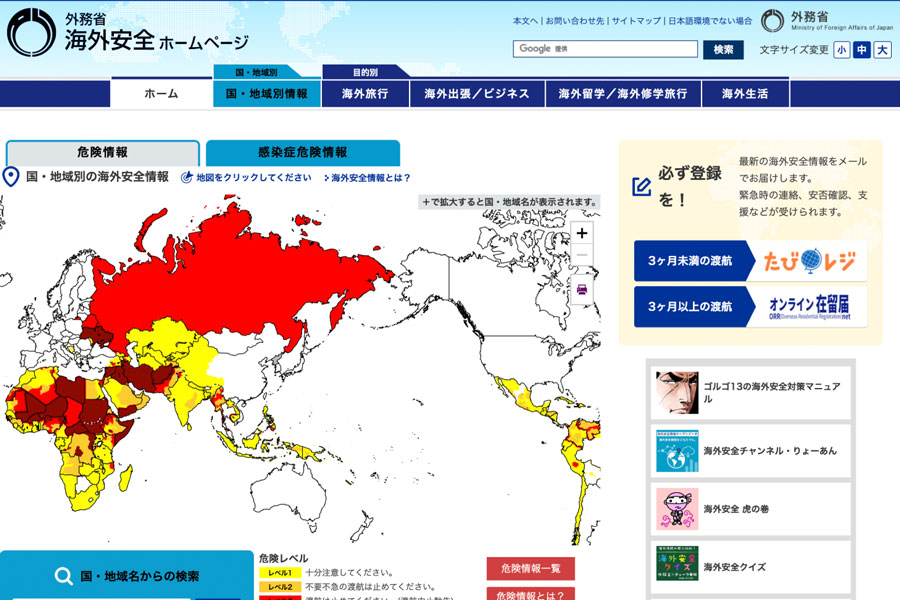
Japan’s Ministry of Foreign Affairs has updated its travel risk information for Israel and Palestine, Iraq, and Lebanon, lowering the risk level for certain areas in each.
The measure applies to areas whose risk levels had been raised due to the worsening situation in the Middle East, taking into account that no attacks have occurred since ceasefire agreements were reached.
For Israel and Palestine, the ministry lowered the risk level from Level 3 (Avoid All Travel) to Level 2 (Avoid Non-Essential Travel) for all areas except the Gaza Strip and its surrounding border areas, and the border region with Lebanon (all remaining at Level 4), as well as areas other than major cities and main roads in the West Bank (remaining at Level 3). The measure reflects the fact that no attacks have occurred since June.
In Iraq, the ministry lowered the risk level for eight southeastern governorates—Babylon, Karbala, Najaf, Al-Qadisiyyah (Diwaniyah), Basra, Al Muthanna, Dhi Qar, and Maysan—from Level 4 (Evacuate and Avoid All Travel) to Level 3 (Avoid All Travel). The decision reflects the absence of attacks from Iran and other sources in these areas since August. All other areas remain at Level 4 (Evacuate and Avoid All Travel). However, travel to and stays in Level 3 areas will not be discouraged where there are genuinely unavoidable circumstances, such as initiatives by companies and organizations contributing to Iraq’s recovery and reconstruction.
In Lebanon, the ministry lowered the risk level from Level 4 to Level 3 for Beirut Governorate; the premises of Rafic Hariri International Airport; Route 51, the main road connecting the airport and Beirut; the Metn and Baabda districts of Mount Lebanon Governorate (excluding the Dahiyeh area in Beirut’s southern suburbs); Keserwan-Jbeil Governorate; and the Batroun, Koura, Bsharri, and Zgharta districts of North Lebanon Governorate. The ministry cited the fact that no attacks by the Israel Defense Forces (IDF) have been confirmed in these areas since the ceasefire agreement took effect in April, as well as a certain easing of tensions under the “three-country framework agreement.” Meanwhile, Level 4 remains in effect for areas including South Lebanon Governorate, Nabatieh Governorate, Beqaa Governorate, and Baalbek-Hermel Governorate, where the IDF continues to maintain a presence and carry out attacks targeting Hezbollah.
Japan’s Ministry of Foreign Affairs said that the possibility of unforeseen developments in all of these countries cannot be ruled out and continues to urge people to refrain from travel. For those who must travel, it calls for obtaining the latest information from multiple sources and exercising caution, including by staying away from military facilities and not taking photos or videos of such facilities, even from a distance.
Notice
This article was generated using automatic translation by GPT-4 API. The translation may not be accurate.