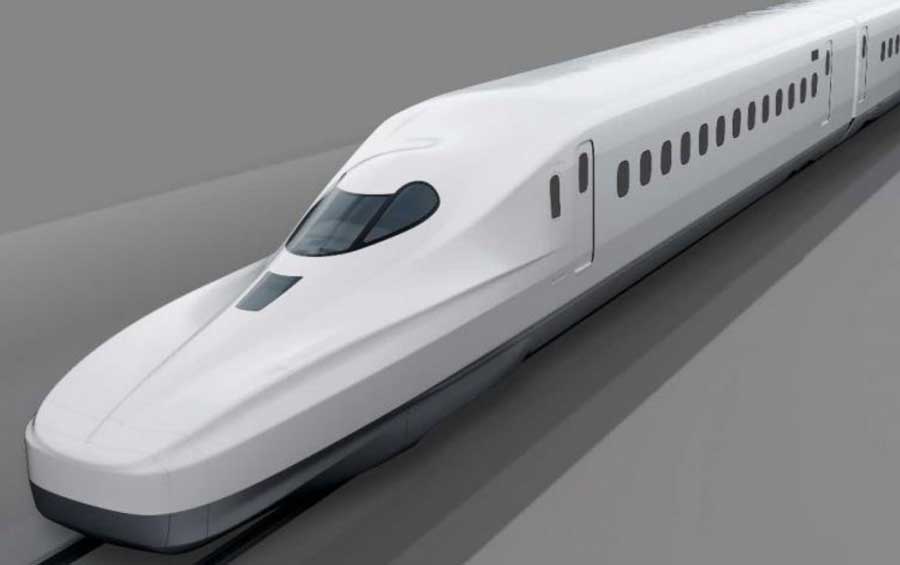
JR Central will introduce its next-generation “S0 Series” rolling stock on the Tokaido and Sanyo Shinkansen lines. Commercial operations are scheduled to begin in July 2029.
Representing the first full model change since the N700S, the name combines “0,” signifying a new starting point for evolution, with “S” for Shinkansen and Supreme, reflecting the train’s status as an innovative vehicle surpassing the current N700 Series.
Its key feature is an automatic train operation system (GOA2, automated operation with a driver on board in the cab). Based on timetable information and other data received via millimeter-wave train radio, the system sets a planned speed for energy-efficient operation. After departure is initiated at the press of a button, the train runs automatically to ensure on-time arrival and precise stopping at designated positions. Even if an unexpected speed restriction occurs while en route, the system automatically updates the planned speed using the latest information to recover from delays and minimize disruption.
For safety, an early earthquake detection system using millimeter-wave train radio will be introduced, reducing the time from earthquake detection to the start of braking from approximately two seconds at present to around 0.2 seconds—roughly one-tenth of the current time. Brake control will also be improved, reducing braking distance during earthquakes by approximately 5% compared with the N700S.
Two types of seating will be offered in the Green Car: “multi-function armrest seats” in Cars 8 and 9, and “partition seats” in Car 10. Car 8 will have 68 seats, Car 9 will have 64 seats, and Car 10 will have 48 seats. Car 10 will also feature six Supreme Class Seats and one Supreme Class Cabin. A powder corner will be added in the vestibule area of Car 9, while the free “S Wi-Fi for Biz” service will also be introduced in Cars 9 and 10. Transparent glass antennas compatible with 5G will be installed in Cars 8 through 10. Improved vibration control using full-active dampers will reduce swaying when passing other trains by approximately 10%.
Across both ordinary-class and Green Cars, luggage storage areas in the vestibules will be increased from six to nine locations. Overhead luggage rack capacity in passenger cabins will be expanded by approximately 25% in end cars and approximately 5% in intermediate cars. Vestibule layouts will also be redesigned: women-only restrooms will be expanded by approximately 25% and equipped with new baby beds, while men-only restrooms will be fitted with sliding doors and washroom entrances will be widened.
For environmental performance, the train will adopt the “Twin LiMEX” nose shape, a further evolution of the N700S front-end design. By reducing air resistance, introducing automatic operation, and efficiently installing onboard equipment, electricity consumption for the entire trainset will be reduced by approximately 6% compared with the N700S. The proportion of recycled aluminum materials used in the carbody structure will also be raised from approximately 14% to approximately 20%.
The deployment plan calls for eight trainsets in fiscal 2029, seven in fiscal 2030, seven in fiscal 2031, and three in the first half of fiscal 2032, for a total of 25 trainsets. One verification test trainset is scheduled to be introduced in August 2028. Plans for deployment from the second half of fiscal 2032 onward have not yet been determined.
Enhanced Green Car services will be introduced in advance on newly built N700S trains entering service from December 2027 onward. Existing N700A and N700S trains will also be progressively retrofitted with some of the S0 Series’ new features.
Notice
This article was generated using automatic translation by GPT-4 API. The translation may not be accurate.