Market research firm Euromonitor International has released findings showing that demand for Asian restaurants is increasing around the world.
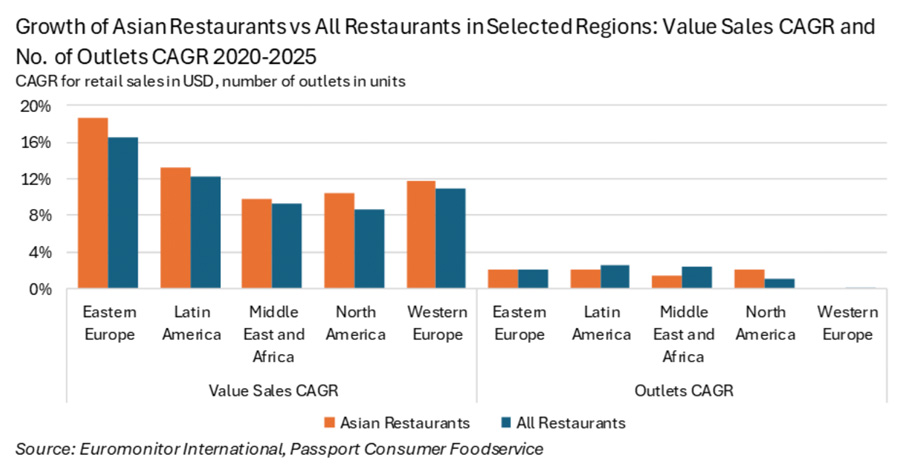
The findings were presented in its report, “Growing Global Demand for Asian Cuisine.” From 2020 to 2025, sales at Asian restaurants grew faster than the overall restaurant industry in every region outside Asia-Pacific. The Asian restaurant market recorded an average annual sales growth rate of 11% during the period, exceeding the 7% rate for the restaurant industry overall. In North America and Western Europe, the growth rate in the number of outlets remained at just 1% to 2%, while the number of outlets declined in Western Europe. The company said that sales growth was not driven by an increase in the number of restaurant openings.
Emil Fazira, Insights Manager for Food in the Asia-Pacific region, said, “This does not reflect a growing presence resulting from rapid outlet expansion, as seen with specialty beverage stores and other small-format businesses. Rather, it reflects a genuine increase in consumer spending at Asian restaurants themselves.”
Rising interest in travel and Asian cultures is behind the trend. One in four travelers worldwide chooses the Asia-Pacific region as a travel destination. According to the company’s 2026 consumer survey, conducted among approximately 1,000 people in each of 39 countries, around one in six consumers globally cited “quality of food” as an important factor when choosing a travel destination, exceeding the share of consumers who said they wanted to experience local culture. More people also want to continue enjoying Asian cuisine they sampled while traveling after returning home.
In the global frozen food market, Korean cuisine ranked fifth among national and regional cuisine categories, recording an average annual growth rate of 15% from 2020 to 2025. Japanese cuisine ranked fourth. Asian cuisine has strengthened its competitiveness by meeting demand from consumers seeking to avoid time-consuming cooking, accounting for 38% of global retail value sales of chilled and frozen foods in 2025.
Fazira said, “For global companies to expand Asian cuisine offerings, it is essential to provide products that can be easily prepared at home. This presents a major growth opportunity for brands that can adapt to local eating habits and preferences—through halal options and adjustments to spice levels by region, for example—while maintaining the distinctive character of Asian cuisine.”
Notice
This article was generated using automatic translation by GPT-4 API. The translation may not be accurate.