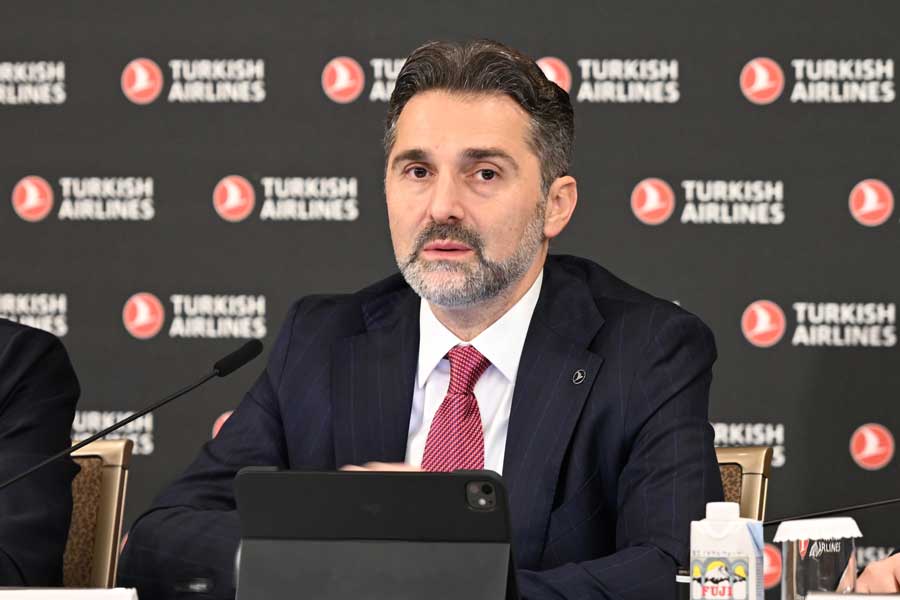
Turkish Airlines Chairman Murat Şeker has indicated that the airline plans to increase flights to Japan.
Turkish Airlines launched services to Tokyo in 1989. It currently operates 10 weekly round trips between Tokyo/Narita and Istanbul, as well as seven weekly round trips each from Tokyo/Haneda and Osaka/Kansai to Istanbul, for a total of 24 weekly round trips. Its immediate top priority is to increase frequencies at these three airports in the two cities. While additional flights at Haneda are not possible due to a shortage of slots, the airline holds operating rights for 14 weekly round trips at Narita and aims to raise services to 12 to 13 weekly round trips next summer, followed by 14 weekly round trips. It also sees room to increase flights at Kansai. Once service levels in Tokyo and Osaka are sufficient, other Japanese cities, such as Nagoya and Sapporo, will also be considered for new routes. Turkish Airlines operates one of its few company-owned lounges worldwide at Tokyo/Narita, underscoring the importance it places on Tokyo.
Of Japanese passengers, around 20% have Türkiye as their final destination, while the remaining 80% connect onward to Europe, South America, Africa, and other regions. Demand is particularly strong for Italy, Spain, Brazil, and other destinations. The number of travelers visiting Türkiye from Japan rose by around 20% year on year in 2025, but the airline does not expect growth in 2026 due to the impact of the conflict in the Middle East. However, it said there has not been a significant decline either.
Regarding the Asian market, the airline explained that it occupies an important position in its growth strategy, as its presence in the region remains relatively limited compared with other regions. For 2026, it had initially planned to expand capacity in the region by more than 10%, but added further capacity after Far East routes remained strong following the start of the conflict. Capacity increased by around 18% to 19% from January through September. The expansion utilized capacity redeployed from Middle East routes and some long-haul routes to the Americas, as well as newly acquired operating rights. Frequencies were increased to Singapore, Malaysia, Vietnam, the Philippines, and China.
As for future new routes, the airline does not anticipate major expansion because it already serves more countries and cities than any other carrier. However, it will add routes as it receives widebody aircraft. It named Lima and Rio de Janeiro in South America, and Orlando in North America, as candidates. It also plans to resume certain African routes that have been temporarily suspended due to the conflict.
For long-haul routes, the airline plans to introduce the Airbus A350-1000ULR and launch nonstop services from Istanbul in the first quarter of 2028, provided there are no delays to its aircraft delivery schedule. It said this would be one of its largest investments for the future.
Premium Economy Class will be introduced starting with newly built Airbus A350 aircraft scheduled for delivery in the fourth quarter of 2028. The airline said it has completed the seat selection process and finalized its plans. It will then progressively install Premium Economy on Boeing 787 aircraft and through cabin refurbishments of existing Boeing 777 aircraft, with the aim of offering the class across its entire widebody fleet. It did not specify when the class would be introduced on Japan routes.
On aircraft procurement, the airline acknowledged that it had been somewhat late to place orders because some airlines ordered early. At the same time, it pointed out that deliveries of the Boeing 787, Airbus A350, and Boeing 777X have all been significantly delayed from schedule. The Boeing 777X is now six years behind schedule, and while Turkish Airlines is considering an order, it said the earliest possible delivery would be in 2036. Its current fleet includes around 30 Boeing 787s, approximately 30 to 35 Airbus A350s, and 33 Boeing 777s, and it said it already has nearly all new-generation aircraft types.
On environmental measures, the airline said it has signed the International Civil Aviation Organization’s (ICAO) 2050 carbon-neutrality target together with the Turkish government, and outlined three pillars. The first is the introduction of fuel-efficient new-generation aircraft, which it said can reduce fuel consumption by 15% to 20% compared with older aircraft. Through orders for nearly 400 new aircraft, it expects 90% of its fleet to consist of new-generation aircraft by 2030. The second is operational efficiency. Through hundreds of annual initiatives, including more efficient flying by flight crews, it aims to reduce carbon dioxide emissions by around 3 million tonnes. The third is sustainable aviation fuel (SAF). In addition to investing in an SAF fund involving Airbus, Qantas, major banks, and others, it has established an SAF development fund with Boeing and a Turkish university of technology. It is also investing in SAF production facilities in Türkiye, with the goal of producing up to 300,000 tonnes annually.
In addition, the airline has introduced an AI-based model for recycling inflight meal waste, is working to obtain LEED certification for its buildings, and has installed solar panels on the rooftops of suitable buildings. It said its headquarters’ electricity demand is met through its own power generation. It has set up a large booth at COP31, currently being held in Antalya, Türkiye, and is participating in two panel discussions.
In terms of investment, the airline said it spends an average of US$4.5 billion to US$5 billion annually, one of the largest amounts in the industry. Alongside aircraft purchases and fleet renewal, it is investing in infrastructure including one of Europe’s largest maintenance facilities, inflight catering facilities, and cargo facilities, while continuing to develop simulator centers and data centers. For financing, its use of Japan’s JOLCO financial product has reached nearly US$3 billion, making it one of the airlines that makes the greatest use of the product.
Regarding the impact of the situation in the Middle East, the airline said jet fuel prices had fallen following the U.S. election and expressed the view that adverse effects would ease by the first quarter of 2027. However, it said the timing of any fuel-price recovery would depend on progress in the peace process. While costs increased by around 27% due to the conflict, it said its revenue growth rate from January through September 2026 was the highest among major European and U.S. airlines.
Notice
This article was generated using automatic translation by GPT-4 API. The translation may not be accurate.