Checking In for a Cruise Is Almost the Same as for a Flight
This time, I arrived in central Naha the day before departure. Most of the people I later met onboard were tour participants who had booked “Fly & Cruise” packages, arriving on the day by air with flights included in their tour price. For individual travelers who book flights and the cruise separately, though, this can be a bit risky. In fact, my travel companion missed the plane because of a derailment incident on the Jōban Line in eastern Japan, so it’s better to allow plenty of time.
The Naha Port Second Cruise Berth, where check‑in is carried out, is about 15 to 20 minutes by car from Naha Airport. Taxi fare is just under 3,000 yen. There is also a shuttle bus service costing 15 US dollars, another example of the ship’s finely tuned pricing. Depending on the tour, this shuttle may be included. Staff members from the cruise company and travel agencies were also present in the arrivals lobby at the airport, which was reassuring.
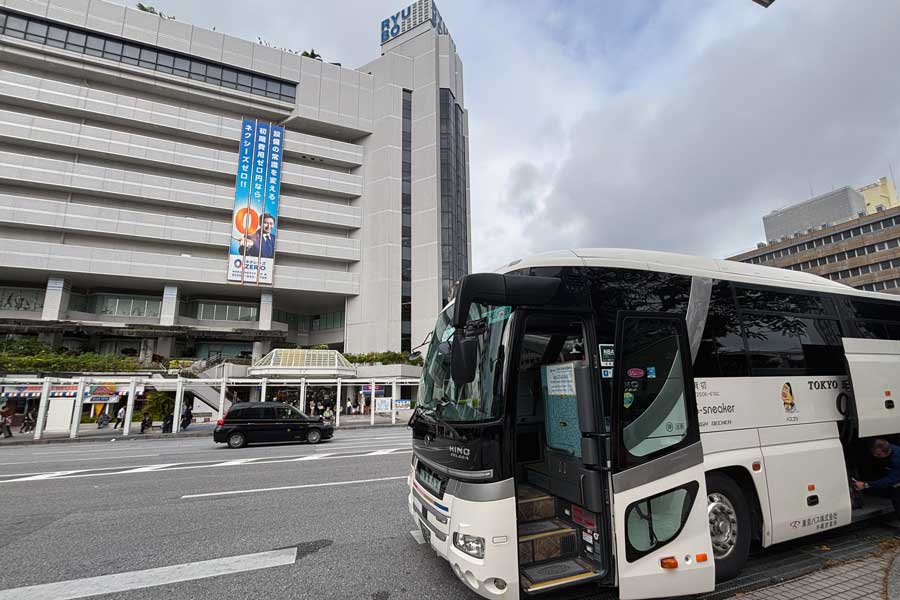
Although MSC Cruises itself did not inform us, I learned the day before departure that there was a free bus running from Kenchō‑mae (the prefectural office area in central Naha). Since the port is a fair distance even from the city center, we took this bus to the pier. In reality, this bus is reportedly not provided by MSC Cruises, but the lack of information was rather unfriendly. Even onboard, some people thought it was for foreigners, while others said they had never heard of it.
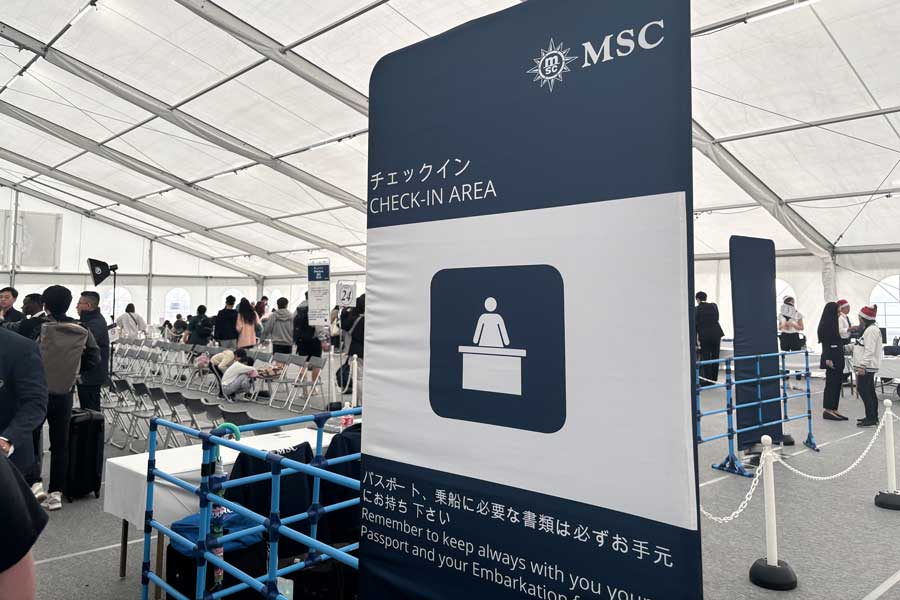
On arrival at the cruise berth, the process flows just like going through departure formalities at an airport. You present the boarding pass that was sent by email in advance and printed out, attach the pre‑printed luggage tag to your checked bags, and hand them over. After baggage screening and check‑in, your photo is taken and linked to your cruise card, and then you board the ship. The cruise card, which also functions as your cabin key, is hanging on the doorknob of your cabin door; you take it from there. Your checked luggage will be delivered to your cabin sometime before nightfall, but you cannot choose the time, so anything you might need immediately is best carried on by yourself.
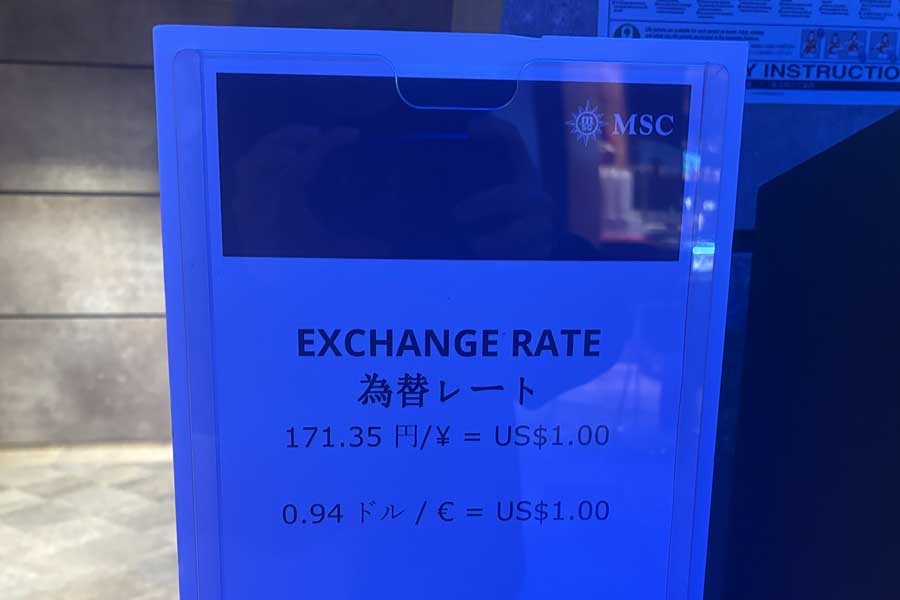
All payments onboard are made with your cruise card. After boarding, you link it to your own credit card at dedicated machines onboard. At some of these machines, you can also deposit cash in Japanese yen, US dollars, or euros. On the final day, your bill is automatically settled, and you can check the details at any time via the “MSC for Me” app. Even casino chips can be purchased with your cruise card, which is convenient, but because everything is denominated in US dollars, your sense of money tends to get a bit blurry. Incidentally, the onboard exchange rate is extremely unfavorable—over 170 yen to 1 US dollar—so it’s better to settle in US dollars on your credit card. If you plan to pay cash, you should exchange for US dollars in advance. Casino chip payouts are made in US dollars in cash, but as there are few opportunities to use that cash later, it is handy to deposit winnings into your cruise account via the machine—if you happen to win, that is.
Participation in the muster (emergency) drill is mandatory. At the specified time, you watch a video on your cabin TV—similar to an inflight safety video on an airplane—then call a designated phone number. After that, you proceed to your assigned assembly point, where your cruise card is scanned to confirm attendance. Since this is an emergency drill, elevators cannot be used, among other restrictions.
This may sound like a bit of a hassle, but once you have done this, you are done with all the formalities. After that, you are free to enjoy the cruise as you wish.
Ishigaki Call Canceled Due to Bad Weather
During check‑in at Naha Port, we were informed that the call at Ishigaki would be canceled due to bad weather.
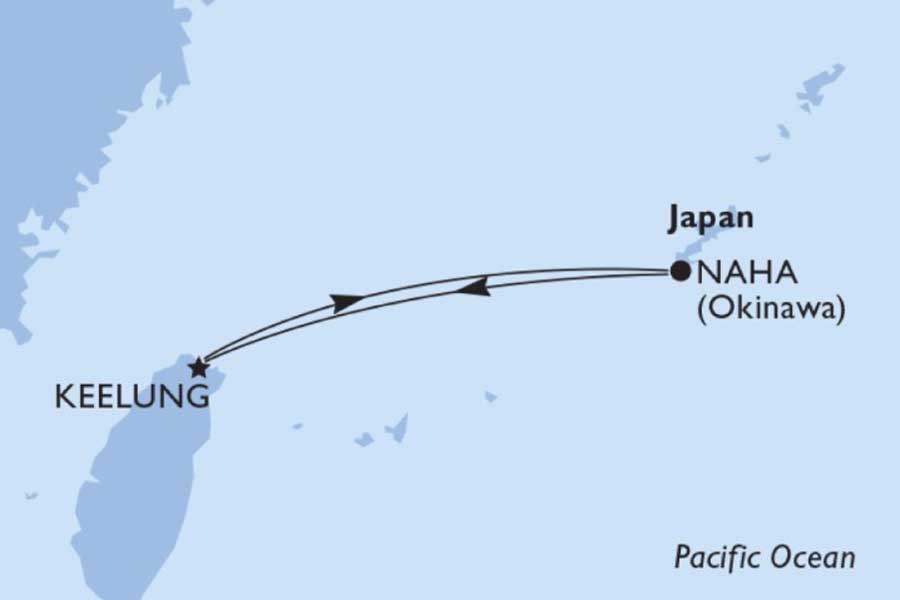
Instead of following the original plan, the ship would sail directly from Naha Port to Keelung. In fact, in December, three sailings (departing on the 13th, 21st, and 25th) skipped Ishigaki, while the sailings on the 5th, 9th, and 17th were able to call as scheduled. In winter, the Nansei Islands in southwestern Japan are very windy and the seas can be rough. Naturally, most passengers want to enjoy sightseeing at the ports of call. While it was disappointing, I decided to think positively: we would now have more time to enjoy the ship itself. In the end, because of high waves, the ship remained berthed in Naha Port that night and did not depart until around 7:00 a.m. the next morning, turning that day into a full day at sea.
Of course, this was not the cruise company’s fault, but as “a gesture of goodwill,” the company gave all passengers a 25 US‑dollar onboard credit. This meant that 25 US dollars were deducted from each passenger’s onboard spending—roughly equivalent to two beers, three soft drinks, or two double‑scoop gelatos.
Where my plan really went off the rails was the communication environment. The original pattern for this cruise was to sail at night and stay in port during the day, so I had assumed I could work using mobile data while in port. Because Ishigaki was dropped, however, we ended up in international waters with poor connectivity during the day. I finally gave in and purchased Starlink Wi‑Fi onboard, but the downside was that I couldn’t switch devices freely; I had to buy access per device. The plan that covered the entire cruise was cheaper than buying day‑by‑day, so I ended up buying coverage for the whole period, making onboard Wi‑Fi my second‑biggest expense after the casino.
Over 1,000 Tour Participants Onboard
Walking around the ship, you saw them everywhere: elderly couples or two‑ or three‑generation family groups, most of them apparently in their late seventies or older, all wearing pink lanyards around their necks with blue cruise cards attached. Looking closely at the logo on the lanyards, I realized they were tour customers of a major Kansai‑based railway-affiliated travel agency, which I’ll call “H Company.” When I asked, I was told that more than 1,000 of them were onboard. These were package tours combining the cruise with air tickets, bringing in huge numbers of customers from across Japan. In other words, it was as if more than 25 full tour buses’ worth of passengers—many of whom only spoke Japanese—had all boarded the ship at once. You can imagine the rest. It was very much a senior‑citizen paradise.
In fact, the Japanese passenger who got into an argument over currency exchange at the casino was an H Company customer, and many people seemed to be nicely drunk every evening. Since the crew was multinational and not specifically optimized for Japanese guests, they were completely overwhelmed. Many passengers with pink lanyards could be seen standing at a distance from the casino tables, not understanding the rules. If the onboard systems were tweaked a bit, the casino might become an even better source of revenue.
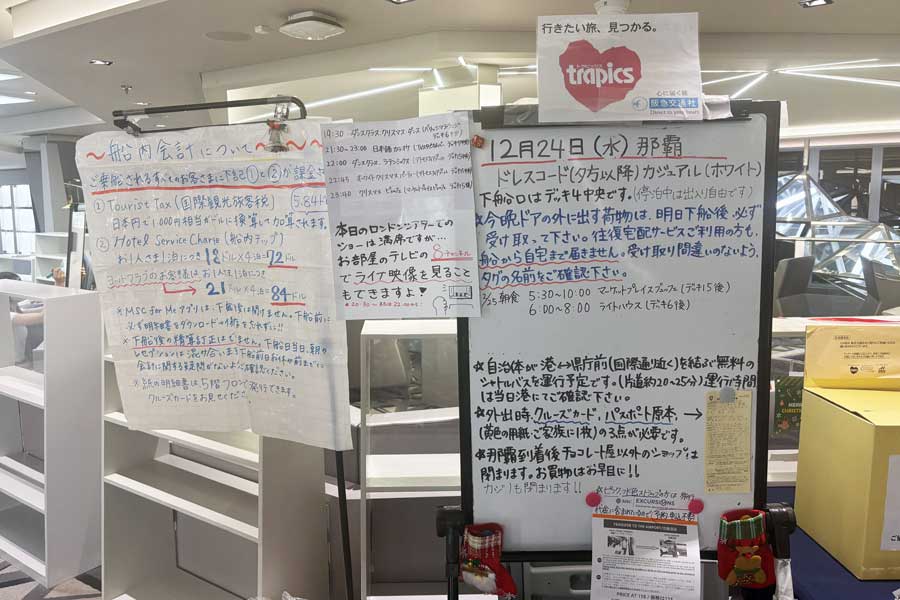
The tour operators had their own tour desks onboard, staffed during the day. They posted various notices for their customers. Smaller travel agencies, by contrast, offered little or no onboard support. Several different agencies had groups onboard, but because H Company’s group was by far the largest, their posted notices were also the most detailed and easiest to understand. If you board without knowing anything in advance, whether you have this kind of support can create a significant difference in your experience and, ultimately, in the price of your package tour. Since the notices were visible to anyone, there was nothing to stop independent passengers from becoming “free riders” and using that information. I actually heard complaints from some tour passengers that support on their own packages was limited.
Elderly couples could be heard saying that the walk to their cabin was a bit long. No surprise there: when you walk back and forth along a 315‑meter‑long ship, you could easily cover close to a kilometer just to get to dinner. When the ship rocks even slightly, walking becomes difficult, and you start to worry about falls. In the narrow corridors, it can be a squeeze just to pass each other. If you are injured or become ill, you need to see the ship’s doctor, and the medical center is not free. It’s essential to take out overseas travel insurance before departure, preferably with unlimited medical coverage or similarly comprehensive terms.
Information Gathering Mainly via YouTube and Social Media
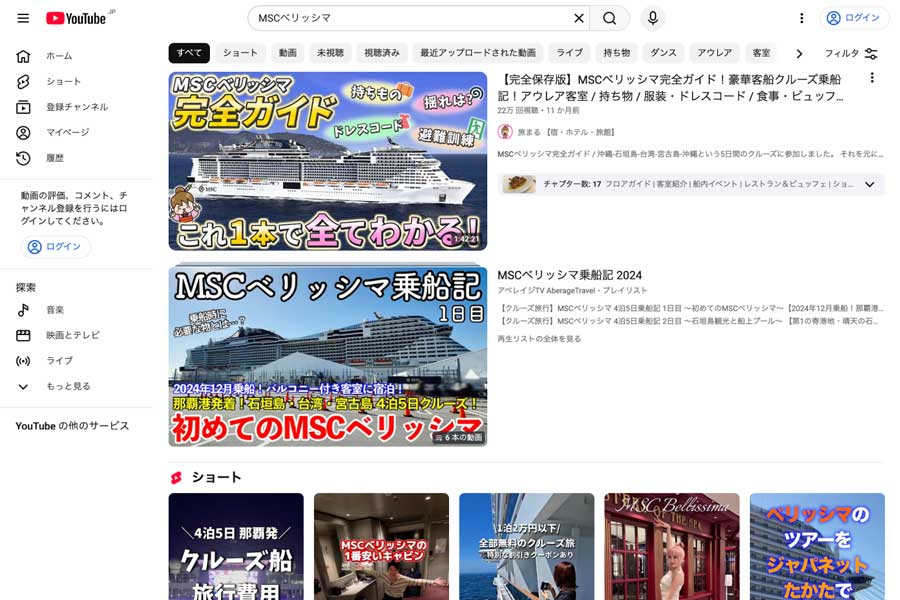
Before boarding, I did some fairly detailed homework for the first time in a while to find out what facilities the ship had. The cruise line’s own website and information, however, were not very helpful—in fact, they were downright unfriendly to first‑timers. In the end, I had to rely on the websites of travel agencies I hadn’t even booked with, as well as personal blogs, social media, and YouTube. There are Facebook groups as well, where people ask questions and post photos from their cruises, and activity there seemed fairly lively.
Many of the people onboard said they had watched influencer videos on YouTube to prepare, but when asked whether those videos were the decisive factor in choosing this cruise, most said no. Instead, they used them mainly to learn what to bring onboard and how best to sightsee at the ports of call. That makes sense. If you suddenly disembark in a city like Keelung—a name many Japanese people can’t even pronounce (it’s “Keelung”)—it’s hard to sightsee efficiently without a plan in place. From that perspective, the abundance of online information may be helping to reduce complaints.
By contrast, H Company’s tour customers were pampered. Their packages came with “selectable shore excursions” at ports of call as an optional extra. Individual travelers can also book shore excursions arranged by the cruise line while onboard, but this is exactly where tours show their strengths. It’s not so much a matter of cost as of suitability. If you’re just going to accumulate dissatisfaction on what should be a special trip, you might as well pay an extra few tens of thousands of yen and have those issues solved.
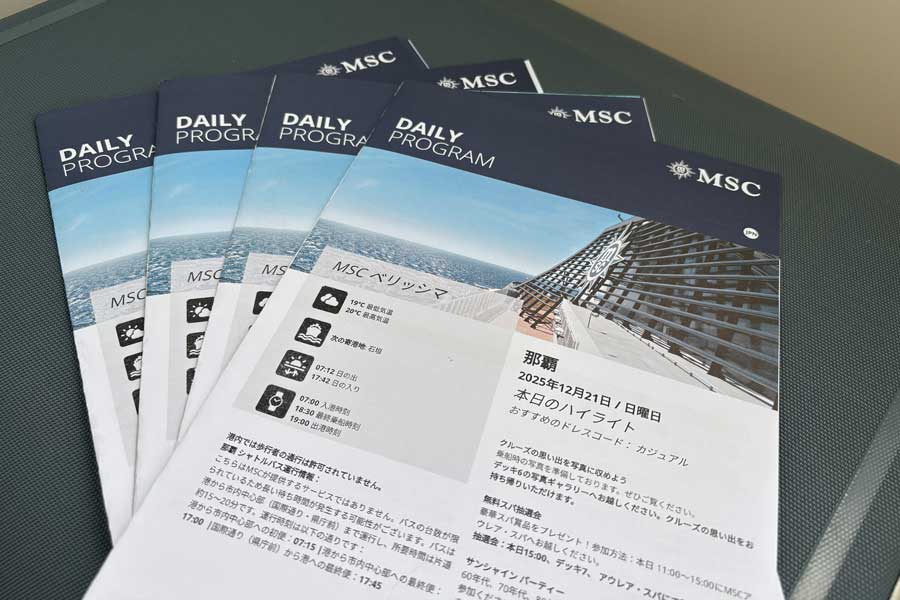
The onboard announcements were also far from user‑friendly, so it was more reliable to actively seek out information yourself (though most detailed information is in English). You should make a point of carefully reading the daily newsletter delivered to your cabin every day. And don’t forget to set up the “MSC for Me” app, which can be used over the ship’s Wi‑Fi.
Notice
This article was generated using automatic translation by GPT-4 API. The translation may not be accurate.