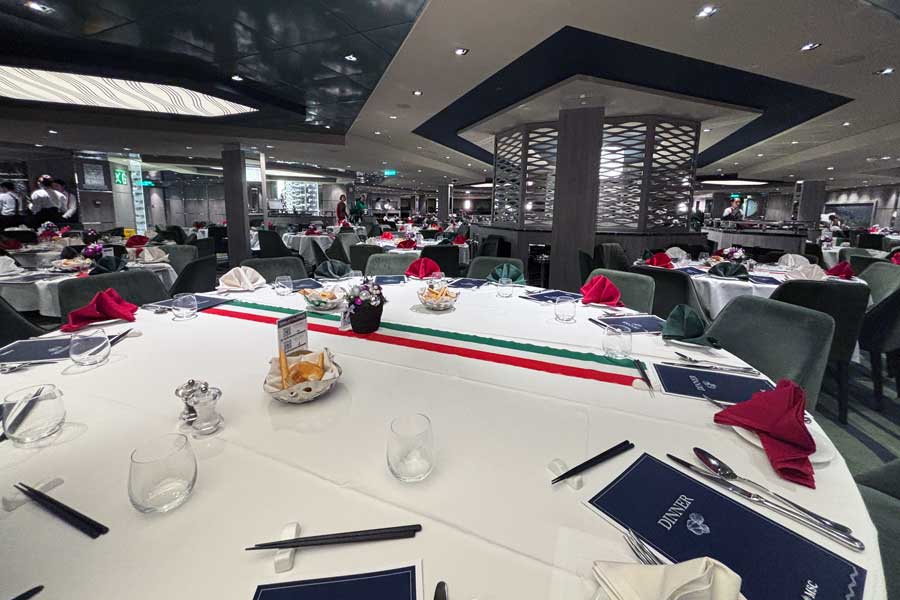
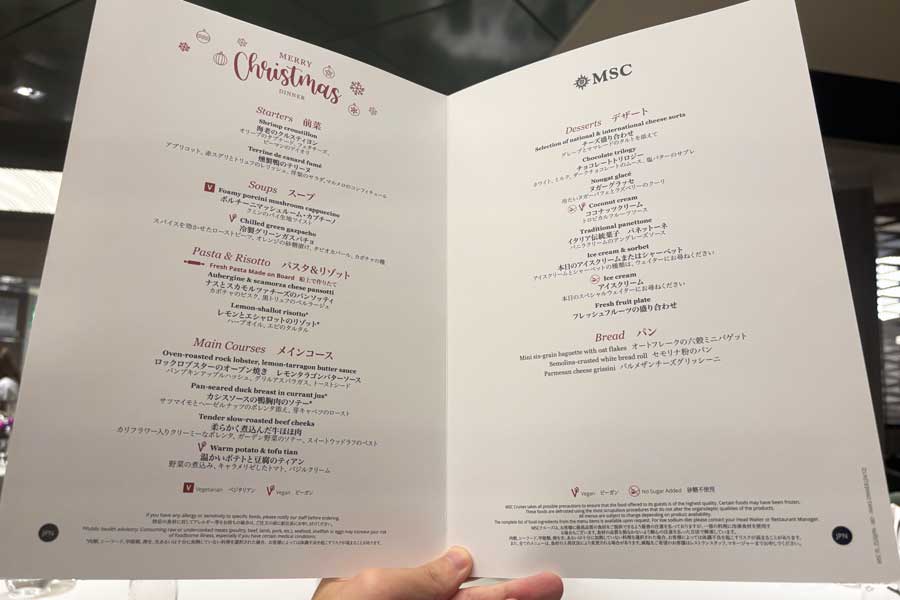
By the way, during the cruise I went to the main restaurant for dinner every day. The restaurant’s location, time slot, and table number are pre‑assigned. The latest seating at 9:30 p.m. suited me well as a night owl. By the time you finish dinner, it’s around 11 p.m., so many people seem to skip it entirely. Quite a lot of seats were empty on most nights, except on Christmas Eve, when a special menu was offered and the restaurant was bustling.
Some passengers assigned to slots around 5 p.m. complained that it was “too early,” but with so many guests, it’s impossible to accommodate everyone’s preferred times. If there are open seats, you can apparently request a change, but most people presumably want that “golden hour” around 7 p.m. During peak times, service can also be slower, so each time slot has its pros and cons.
For lunch, you can go to the main restaurant within the designated hours and be seated at whatever table is available. There are large shared tables and smaller tables, so you can also enjoy interacting with the people around you. Meeting people by chance like this is one of the pleasures of travel.
The dinner menu offers a wide variety of appetizers, mains, and desserts, and you can choose as many items as you like. If you want to take your time and enjoy a sit‑down meal, the main restaurant is recommended, but depending on what you pick, the buffet can sometimes feel higher in quality.
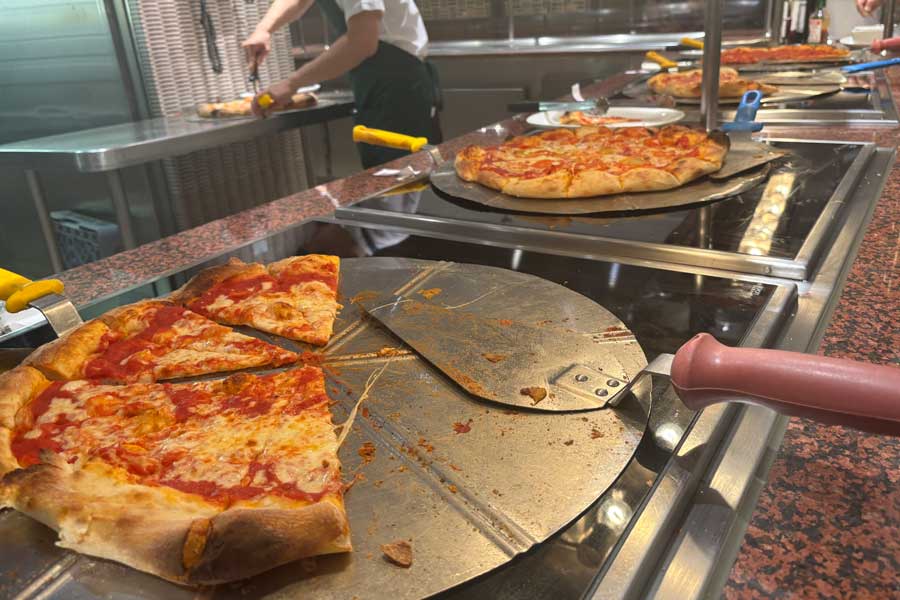
The buffet, which is open almost all day, boasts an impressive variety of dishes, including several Japanese and Taiwanese options. There is always rice and miso soup available, so those who prefer Japanese food can feel at ease. The standout item is, unsurprisingly on an Italian‑owned ship, the pizza. The pizzaiolos keep baking nonstop, yet each fresh batch disappears almost immediately. I ended up visiting the buffet for pizza as a nightly snack.
According to someone connected with the operation, food supplies for this itinerary are loaded in Keelung, and the quality is slightly lower than what is loaded in Japan. When many passengers leave large amounts of food uneaten, the cruise line has to adjust purchasing to control both food waste and budget. At the Christmas buffet that started at 11:30 p.m. on Christmas Eve, I saw several foreign passengers piling far more food on their plates than they could possibly eat, just to take photos. Given how much people nowadays live with an eye on how things will look on social media, perhaps this is unavoidable.
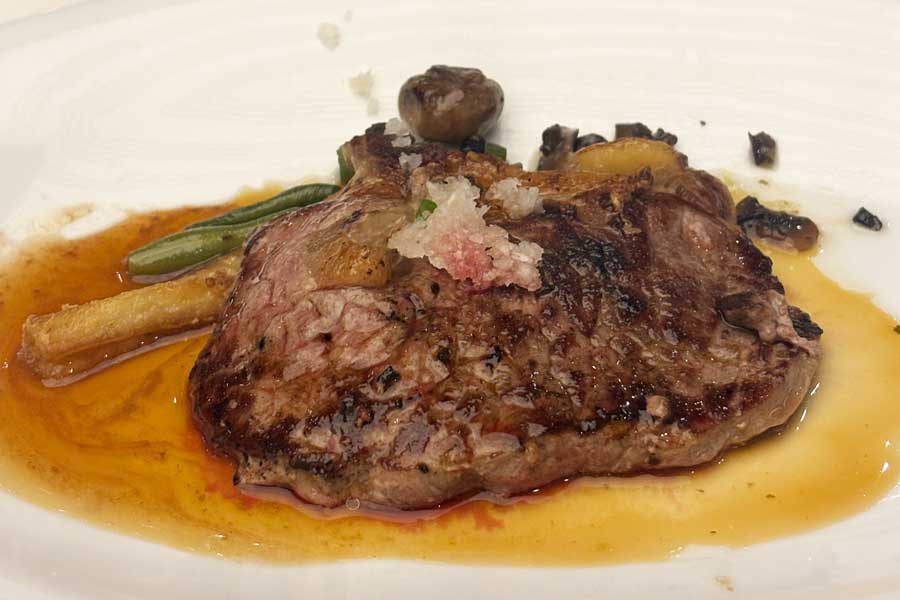
On the third night, after departing Keelung, sirloin steak appeared on the restaurant menu. My companion had been looking forward to it, but in the end I was served a piece that was mostly tough fat with little edible meat, while my companion received a portion roughly twice as large—apparently matched to their body size. You couldn’t choose the doneness; everything was served well‑done. Elderly passengers would probably find it impossible to chew, if not risk dislodging their dentures. Honestly, it was a solid zero out of ten.
By comparison, the roast beef carved by the chef at the buffet was much more tender and delicious. Personally, I felt that Italian dishes were the likeliest to be “hits” among the many menu options.
Relaxing Day at Sea, Special Events on Christmas Eve
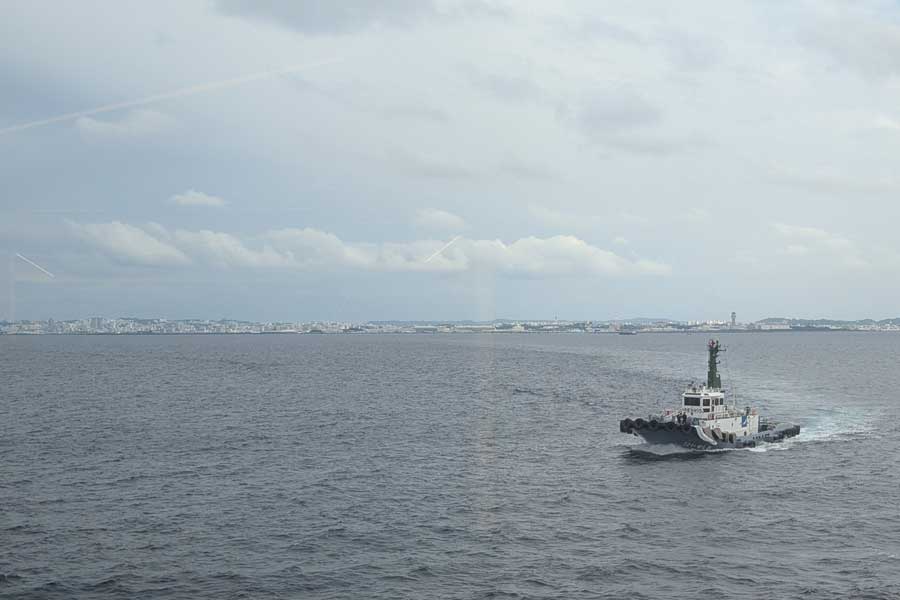
The voyage back to Naha Port progressed smoothly, with occasional sunny spells and very little motion, making for an elegant cruise. As Naha Airport came into view on the starboard side, a pilot boarded from a small boat that had come out to meet us. The ship arrived at Naha Port on schedule.
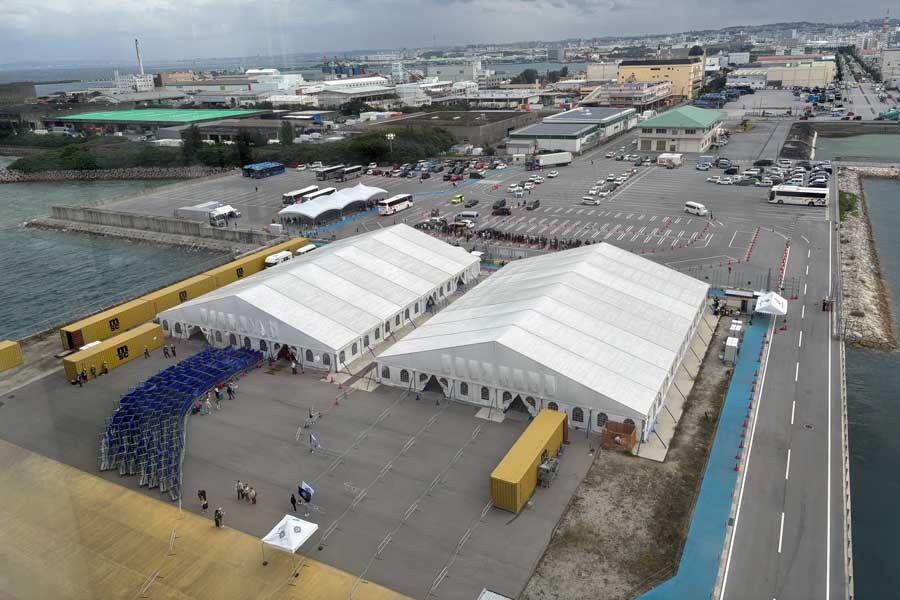
On the same morning, passports stamped in Keelung, instructions for Japanese immigration, and customs declaration forms were delivered to our cabins. Although this is a 5‑day cruise, you must disembark at the designated time on arrival day to complete immigration procedures. Carrying only our passports, customs forms (which I hadn’t filled out by hand in quite some time), and cruise cards, we went ashore, passed through immigration and quarantine with no luggage, and then reboarded the ship.
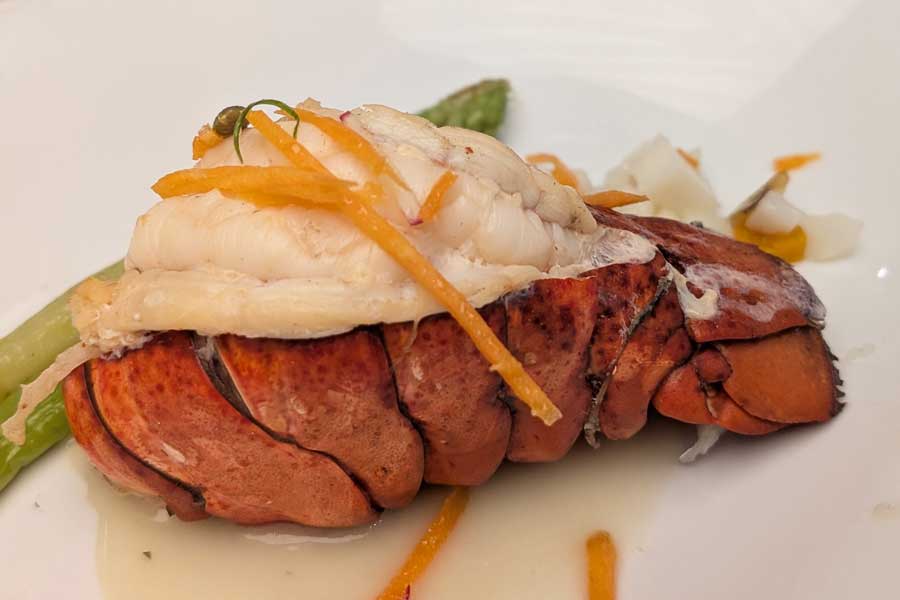
Although the ship was now docked and no longer sailing, the itinerary still counted this as the fifth day. It was Christmas Eve. My travel companion, who has a deep interest in food, had looked up the restaurant menu and was very excited to find special dishes such as lobster being offered. Many passengers apparently went shopping or sightseeing ashore in Naha, but the restaurant was very lively on this final night.
After appetizers, soup, and a pasta & risotto course, the main dish was “Oven‑baked rock lobster with lemon tarragon butter sauce.” Since there is no limit of one main dish per person, my companion also ordered “Slow‑braised beef cheek.” For those with self‑control, this is a wonderful system; for those without, it’s a one‑way ticket to the land of overeating. Many passengers seemed to be racing straight down the highway of weight gain.
On this night, sparkling wine was also served free of charge—a very generous gesture.
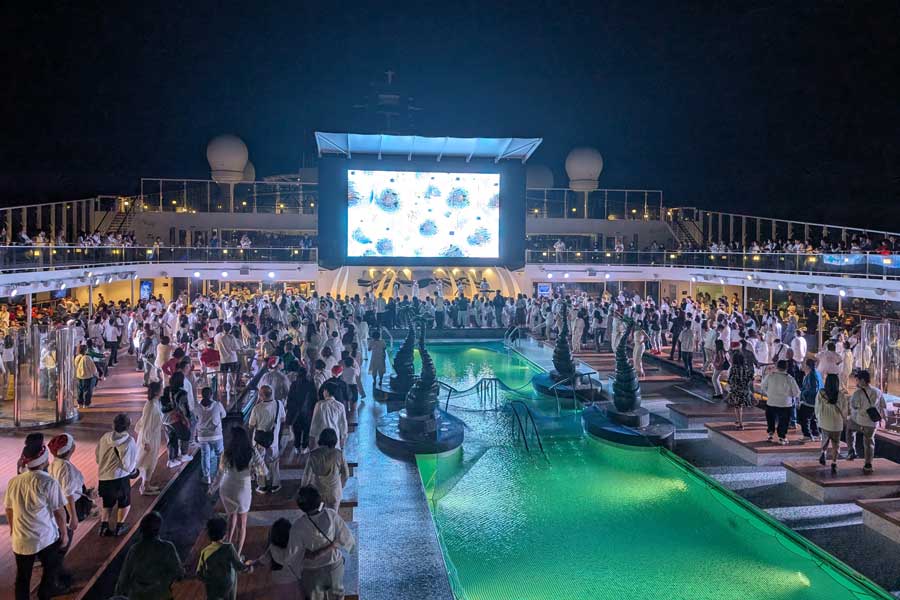
There was also a Christmas event held poolside that evening, which drew quite a crowd. At a cruise ship moored in dark Naha Port, a multinational group of men and women of all ages danced to “Gangnam Style” at full volume. From where we were standing near the back, we didn’t spot any of the pink‑lanyard ladies, but they were no doubt up front in the thick of it. For those who had overeaten at dinner, it was a good opportunity for some exercise.
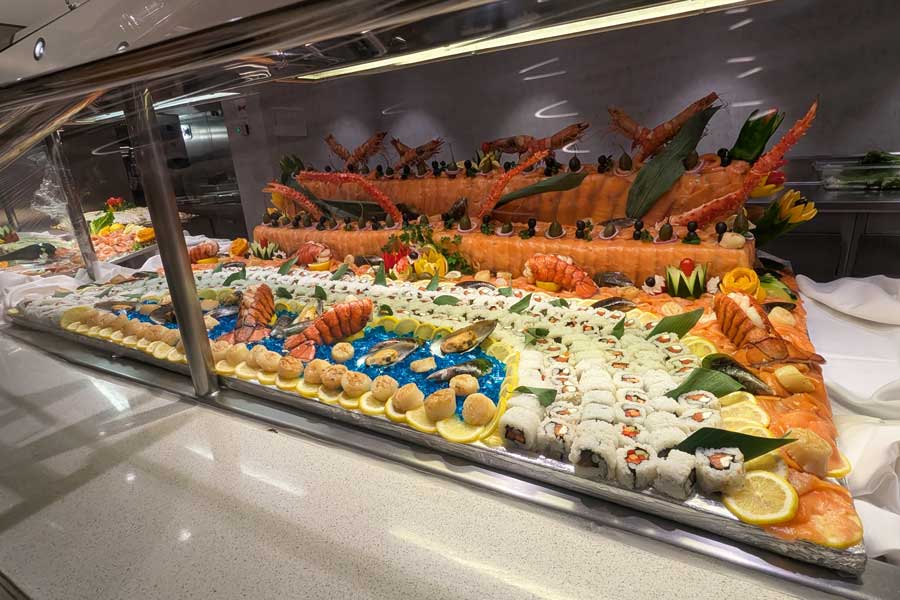
And that wasn’t all. At 11:30 p.m., a “Christmas Buffet” was scheduled. To repeat the important detail: the buffet started at 11:30 at night. At a Japanese business hotel chain like Dormy Inn, even the late‑night ramen service would have finished by then. So we were very curious about what kind of spread would be offered at such an hour. When we arrived before opening, a large crowd was already waiting, and the venue quickly became packed. Hungry passengers poured in straight from the Christmas event as well.
The displays exceeded expectations—an abundance of Japanese and Western dishes that you would never imagine being served at midnight. Passengers were taking photos and videos of the food from every conceivable angle. With the taste of lobster still lingering in my stomach, I carefully chose and served myself only small portions, while everyone else piled their plates high to overflowing. And so Christmas Eve night wore on.
Disembarkation the Next Morning, Reluctantly Saying Goodbye
The next morning, we were asked to vacate our cabins by 8:00 a.m. The next departure was scheduled for 7:30 p.m. that same evening, and the crew needed to clean all the cabins in the short time before the next guests boarded. If you put your luggage in the corridor outside your cabin door with the correct tags attached by 2:00 a.m., it would be taken off the ship for you. Keeping only the clothes we needed for the next day, we finished most of our packing late at night.
Passengers were divided into more than 10 disembarkation groups. High‑tier loyalty members and those booked in higher cabin classes could disembark earlier. Until your group was called, you could still have breakfast at the buffet. We took light buffet items to the poolside area and spent the time working. Our group was called a little after 10:00 a.m., and we disembarked with surprising speed.
And with that, our 5‑day cruise came to an end. Escaping the cold winter skies of Tokyo to spend time in Okinawa and the South China Sea, where warmth still lingered, was a wonderful change of pace. As an introductory cruise for beginners, this itinerary felt ideal. For anyone considering a longer voyage, such as around Japan or even around the world, I would recommend trying a short‑duration cruise like this first.
Many cruises, not only those run by MSC Cruises, are scheduled to operate this year, and they are also being sold as part of year‑end and New Year’s sale campaigns by Japanese travel agencies. If you have ever been curious about cruises, this might be the perfect year to take on the challenge of a cruise trip.
Notice
This article was generated using automatic translation by GPT-4 API. The translation may not be accurate.