There are countless suitcases on the market that claim to be “carry-on compatible,” but most are designed to fit in the overhead bin. Surprisingly, it is rare to find a suitcase specifically marketed as one that can be stored under the seat.
That is where this innovative suitcase, found at Primark in London, comes in. It was designed around the concept of fitting under the seat. It attracted some attention in 2025, and although the author had been looking for one, it had been difficult to find. It has now reappeared for the summer travel season.
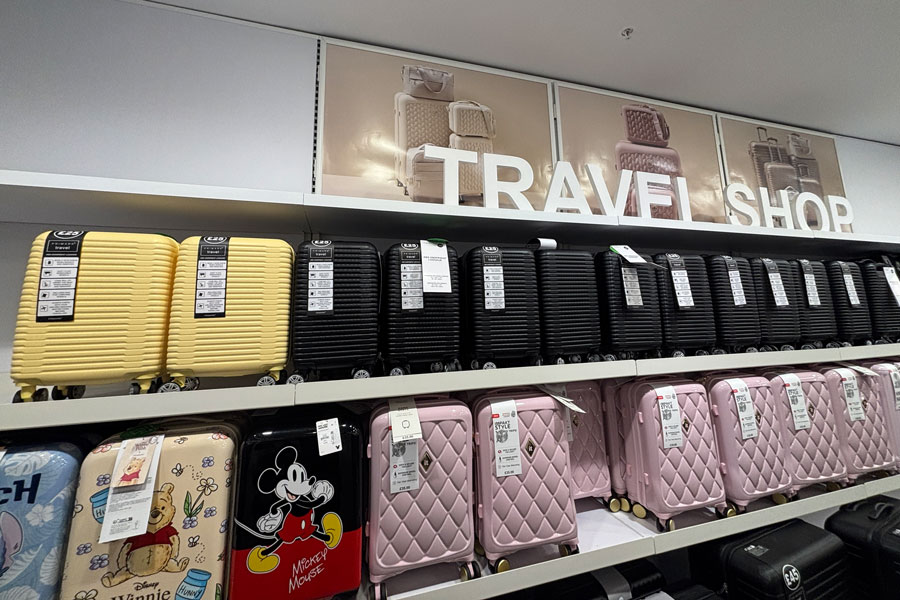
Primark is known as a major fast-fashion retailer, but its travel goods section, the “TRAVEL SHOP,” is also surprisingly well stocked. It offers a wide range of suitcases, Boston bags, travel pouches, and more. Suitcase sizes range from standard carry-on models to ones that are right at—or perhaps over—the checked-baggage limit. Most suitcases can be purchased for around 10,000 yen, making them as affordable and consumer-friendly as the retailer’s clothing.
Here, we introduce the underseat suitcase purchased there.
It Is Called “Underseat Luggage”
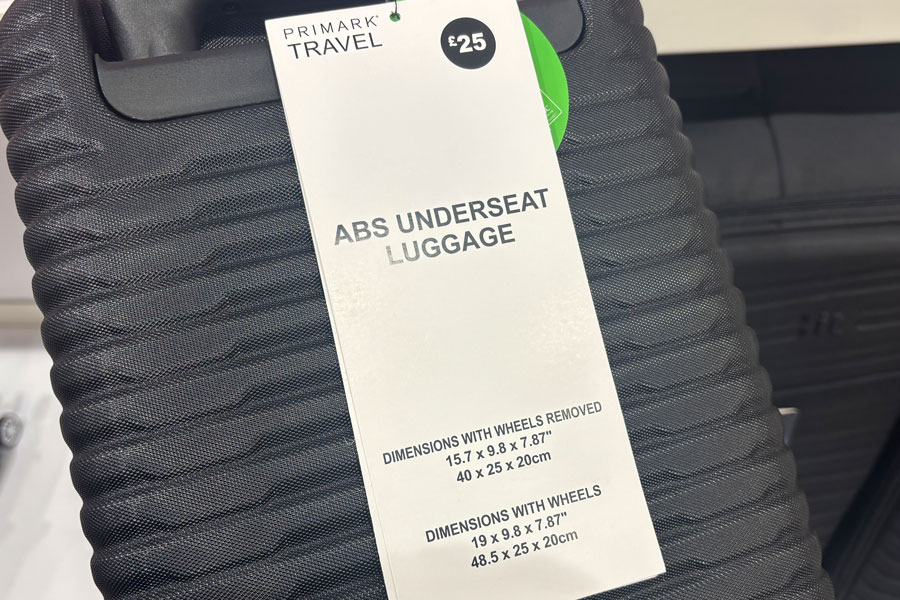
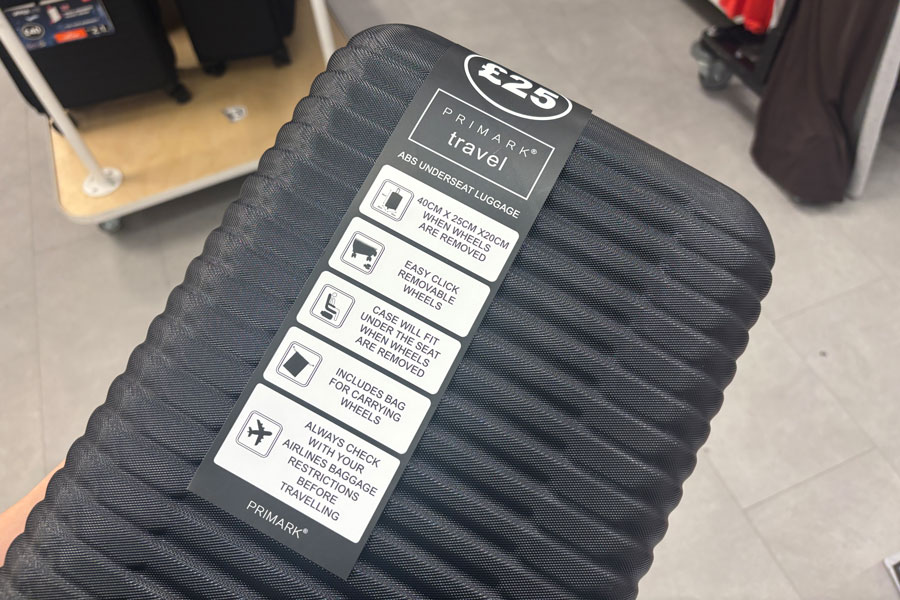
The product is called “ABS UNDERSEAT LUGGAGE.” ABS is a resin material, making this a hard-shell suitcase. It costs £25 (approximately 5,450 yen). For a suitcase available at this price point in London, it is sturdy and offers excellent value for money.
Fine horizontal ribbing makes dirt and scratches less noticeable. It is available in five color options: two types of black, yellow, pink, and blue. While it does not have a TSA lock, the zipper has holes for attaching a padlock.
Above all, the suitcase’s key feature is its compact size, designed to fit under the seat. The interior has a divider, and, uniquely, all four wheels can be removed. It even comes with a dedicated pouch for storing the wheels.
In its standard configuration, it measures 48.5 cm × 25 cm × 20 cm. With the wheels removed, it becomes a compact 40 cm × 25 cm × 20 cm.
How It Compares With Airlines’ Personal-Item Size Rules
In recent years, an increasing number of airlines—particularly low-cost carriers—have tightened size restrictions for “personal items” that passengers can bring on board without an additional charge.
With the wheels removed, the Underseat Luggage purchased this time meets all of these standards in both width and depth. For travelers who frequently use LCCs while traveling in Europe, it may be a design that makes complying with such strict size requirements easier.
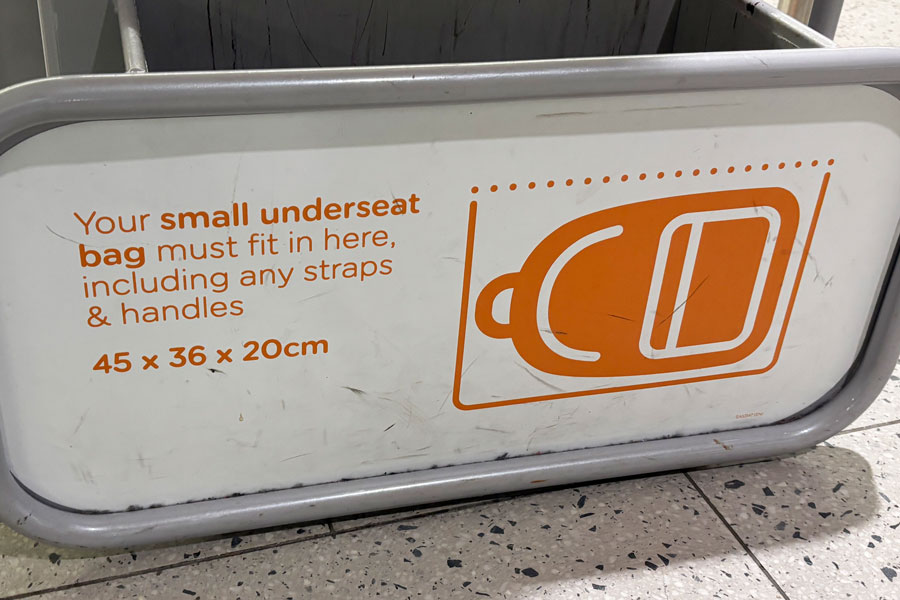
Testing It in an easyJet Baggage Sizer at Gatwick Airport
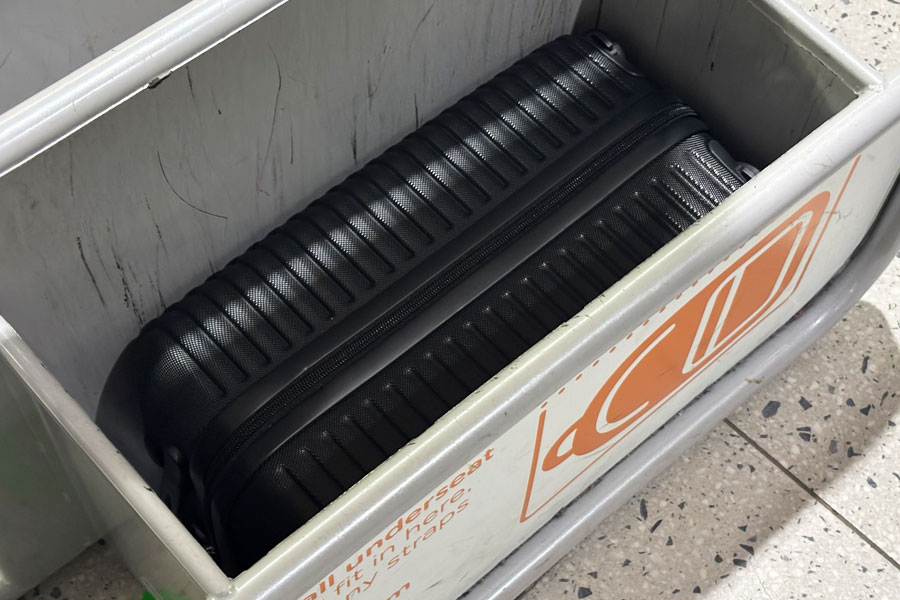
An easyJet personal-item baggage sizer was installed in the check-in area at London Gatwick Airport, so we tried it out. With the wheels attached, the suitcase caught on the frame, but once they were removed, it fit perfectly. This should make it possible to take it on board without anyone objecting.
The issue, however, is where to put the removed wheels. Storing them inside the suitcase takes up a fair amount of space.
A Product of the “No-Holds-Barred Battle Between Passengers and Airlines”?
On Japanese LCCs, passengers are generally free to bring baggage onboard within the limits on the number of items and total weight, provided it meets cabin-baggage size requirements. In Europe, by contrast, it is common for only bags that fit under the seat to be free of charge—creating the conditions for products like this to emerge.
For example, if you accidentally bring an oversized bag when flying Ryanair and have to check a 10 kg bag, you may need to pay up to £40 (approximately 8,700 yen) at the airport counter or £60 (approximately 13,060 yen) at the gate. In some cases, that is more expensive than the airfare itself. If a £25 suitcase can eliminate that concern, it may seem like a bargain. Incidentally, there is no weight limit for the personal item.
After purchasing it, the author felt that this suitcase embodies a microcosm of the “no-holds-barred battle between passengers and airlines.” Realistically, there are probably not many occasions when a passenger needs to pack enough personal belongings to require wheels, and a soft bag such as a backpack should offer better packing efficiency. On the other hand, with a soft bag, it is easy to overpack and exceed the size limit. In that sense, its hard-shell construction can help remove that concern.
Still, the fact that hard-shell wheeled suitcases occupy a proper place on the shelves of the travel shop suggests that, as airlines make personal-item size rules stricter each year, there is a certain level of demand from travelers who want a bag that is right at the limit while still being easy to roll. It may in fact be a hidden hit product. It is a rather modern and unusual item born from the ongoing battle over baggage rules.
■
Primark should not be underestimated as a place to browse travel goods while shopping for clothes. The Underseat Luggage introduced here is an unusual item ideally suited to travelers hoping to avoid additional carry-on charges, as well as those looking for a secondary bag for short domestic trips or business travel. If you have a chance to stop by Primark, why not take a look at its TRAVEL SHOP section as well?
Notice
This article was generated using automatic translation by GPT-4 API. The translation may not be accurate.