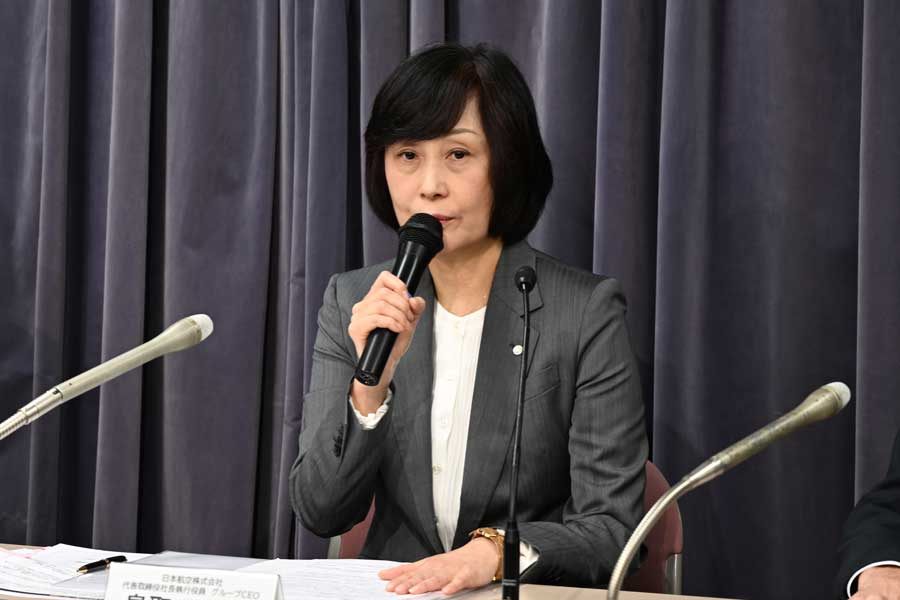
Japan Airlines (JAL) held a briefing on its interim financial results for the fiscal year ending March 2027, where Representative Director and President Mitsuko Tottori and others discussed improvements in domestic flight profitability and the outlook for fuel prices.
Asked during the question-and-answer session about ANA Holdings’ plan to make RegionalPlus Wings a wholly owned subsidiary, President Tottori said, “It is ANA’s decision, so what I say about it is a separate matter.” She added, “The domestic market is in an extremely challenging environment, so we are focusing on how to create a profitable structure while maintaining the network.”
Regarding a possible reallocation of Haneda Airport slots that may accompany the full acquisition, she explained, “Rather than whether there will be a reallocation, the priority is what needs to be done to maintain the domestic network.” Asked whether JAL would seek to receive slots, Tottori said, “It would be untrue to say we would not be interested if that happens, but we are not considering anything at this time.”
On strengthening relationships with mid-sized airlines such as Fuji Dream Airlines, she said, “There is nothing in particular that we are considering at present,” while adding, “We will continue to strengthen relationships as necessary to build a highly convenient network while maintaining profitability on domestic routes.”
JAL explained that, for domestic flights, the number of revenue passengers during the period declined 2.2% year on year, while the average fare rose 8.2% to more than 17,000 yen, an increase of around 1,200 yen from the same period a year earlier. Group CFO Yuji Saito referred to the target of achieving a 10% domestic flight profit margin in 2028, saying, “In terms of fares, we envisage an increase of about 10%. However, costs are rising every year, and we expect annual cost escalation of 4% to 5% even on domestic services, so fare increases will need to continue.” Regarding a domestic fuel surcharge that JAL aims to introduce in April 2027, he said, “We are coordinating with the Civil Aviation Bureau to finalize the system. We believe we will be able to announce it within the year.”
On the fuel price outlook, he said, “If Singapore kerosene is in the range of US$150 to US$160, achieving our plan is fully possible. It is currently somewhat high at around US$170, but we aim to firmly achieve our annual plan through how we manage revenue and costs.” Meanwhile, regarding the impact of the Japanese government’s phased reduction of fuel subsidies, he said, “It would be untrue to say there is no impact at all, but we have anticipated it. If current exchange-rate and fuel-cost conditions continue into the second half, we can reach our EBIT target even without subsidies.”
Notice
This article was generated using automatic translation by GPT-4 API. The translation may not be accurate.