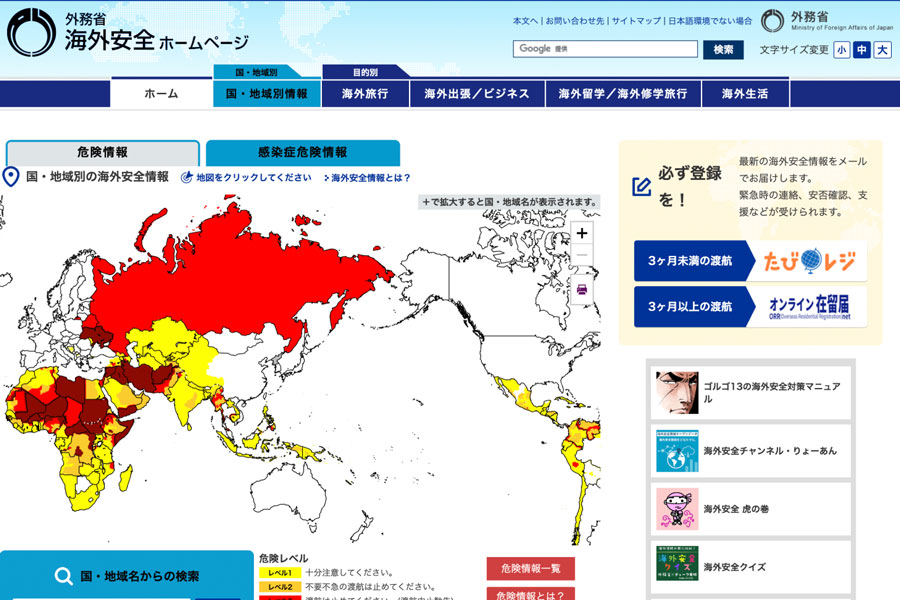
Japan’s Ministry of Foreign Affairs has updated its travel advisory for India, lowering the risk level for certain areas of Meghalaya state in the northeast.
In Meghalaya, the risk level for all areas other than East Khasi Hills district, Ri Bhoi district, West Jaintia Hills district, and East Jaintia Hills district—where Level 1 (Exercise Caution) has already remained in effect—has been lowered from Level 2 (Avoid Non-Essential Travel) to Level 1. The decision was made because the activities of armed groups have declined and the security situation has improved in these areas as well.
Noting that terrorism and other incidents continue to occur in the northeastern states surrounding Meghalaya, the ministry urges travelers and residents to exercise sufficient caution, including by seeking the latest security information from multiple sources.
For other areas in the northeastern states, Level 2 (Avoid Non-Essential Travel) remains in effect for Manipur; four northeastern districts of Assam (Sivasagar, Dibrugarh, Tinsukia, and Charaideo); and Nagaland. In Manipur, attacks on security personnel and civilians, as well as protests, have reportedly continued since inter-ethnic clashes broke out in May 2023 between the majority Meitei community and the minority Kuki community.
For the Union Territory of Jammu and Kashmir and the Union Territory of Ladakh, Level 4 (Evacuate and Avoid All Travel) remains in effect near the Line of Control (LoC); Level 3 (Avoid All Travel) remains in effect for areas of Jammu and Kashmir other than Srinagar and its surrounding areas, areas near the LoC, and Ladakh; Level 2 remains in effect for Srinagar and its surrounding areas; and Level 1 remains in effect for Ladakh. In Jammu and Kashmir, a terrorist attack near Pahalgam in April 2025 killed 26 civilians, including foreign tourists. In March 2026, clashes also occurred between security forces and crowds protesting the death of Ayatollah Khamenei, Iran’s former Supreme Leader.
In the central and eastern states, Level 2 remains in effect for eastern Maharashtra (Gadchiroli, Gondia, and Chandrapur districts); remote plateau areas of Andhra Pradesh, Telangana, Odisha, and Chhattisgarh; and rural areas of Jharkhand and Bihar. Although the destruction of the far-left extremist Maoist organization was announced in March 2025, crackdowns and sporadic fighting have reportedly continued since then.
Level 1 remains in effect for all other parts of India, including major cities such as Delhi, Kolkata, Chennai, Mumbai, and Bengaluru. In November 2025, a bombing in Delhi killed more than 10 people, and Indian authorities have called for heightened vigilance. In addition, from June through July, the “Cockroach People’s Party” (CJP), which was “formed” by young people frustrated by suspected leaks of university entrance examination questions and high youth unemployment, staged large-scale protests in Delhi and attempted to march to the Parliament building in July. Security authorities forcibly dispersed the protesters using tear gas and other measures, resulting in numerous injuries.
The Ministry of Foreign Affairs notes that India has a number of extremist organizations advocating secession from the country and carrying out terrorist attacks in various locations. It also states that Indian authorities are urging vigilance against terrorism by Islamic extremists and others in major cities. The ministry calls on travelers to take safety precautions, such as gathering the latest security information from multiple sources and paying attention to their surroundings, in order to avoid becoming involved in unforeseen incidents.