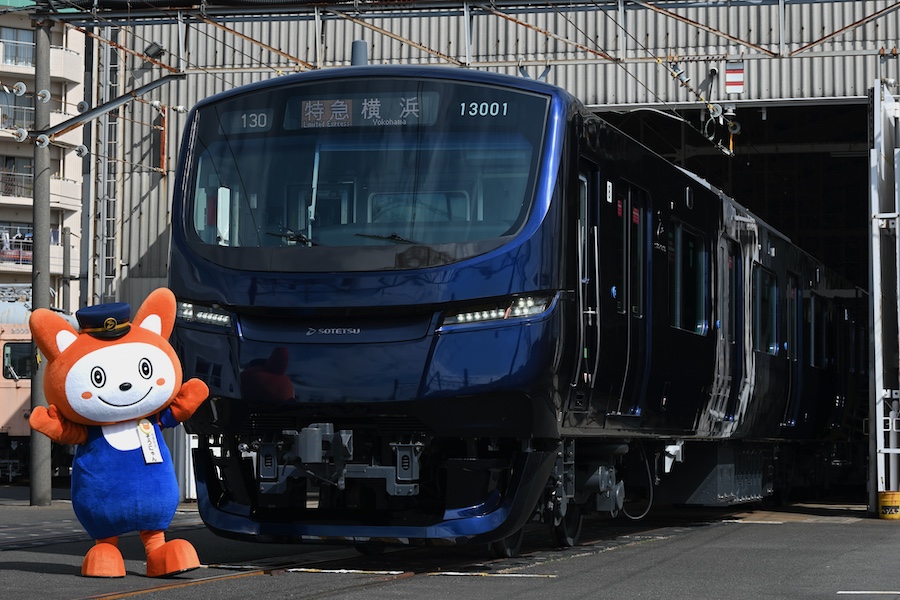
Sagami Railway has announced that it will begin commercial operation of its new “13000 series” train on March 30. In fiscal 2025, one 8-car trainset will be introduced and operated exclusively on Sotetsu lines, without through-service operation onto other railway companies’ lines that are directly connected to the Sotetsu network.
As with the 12000 series used on the Sotetsu–JR through-service line, the car body adopts “sustina,” the all-stainless-steel railway vehicle brand from J-TREC (Japan Transport Engineering Company). The front-end design has been revamped from the 12000 series by removing the front grille and newly introducing a center panel. Meanwhile, by reducing the size of the crushable zone on the end cars, the number of seats in the end cars has been increased by 6 per car, for a total of 12 additional seats. In anticipation of potential one-person (driver-only) operation currently under consideration on Sotetsu lines, an in-car ITV monitor has been installed in the driver’s cab.
The passenger cabin shares the same equipment as the 12000 series and is unified with a gray-based color scheme. Glass luggage racks, partitions, and gangway doors are used to create an open-feeling interior. All cars are equipped with free spaces for strollers and wheelchairs, and some priority seats use universal design seats with smaller seat surfaces. The interior also features mirrors, a tradition of Sotetsu trains, as well as interior lighting whose color tone changes depending on the time of day.
From an environmental standpoint, the train is equipped with the same IGBT-element VVVF inverter control system as the 12000 series, reducing traction power consumption by up to 39% per car compared with the 8000 series. The air compressor, SIV (static inverter) auxiliary power supply, and other onboard equipment share a common design with the 12000 series, helping to reduce design and maintenance costs and to standardize spare parts.
Although the final number of trainsets to be introduced is still under consideration, there are plans to gradually replace the existing 8000 series and 9000 series trains.
Notice
This article was generated using automatic translation by GPT-4 API. The translation may not be accurate.