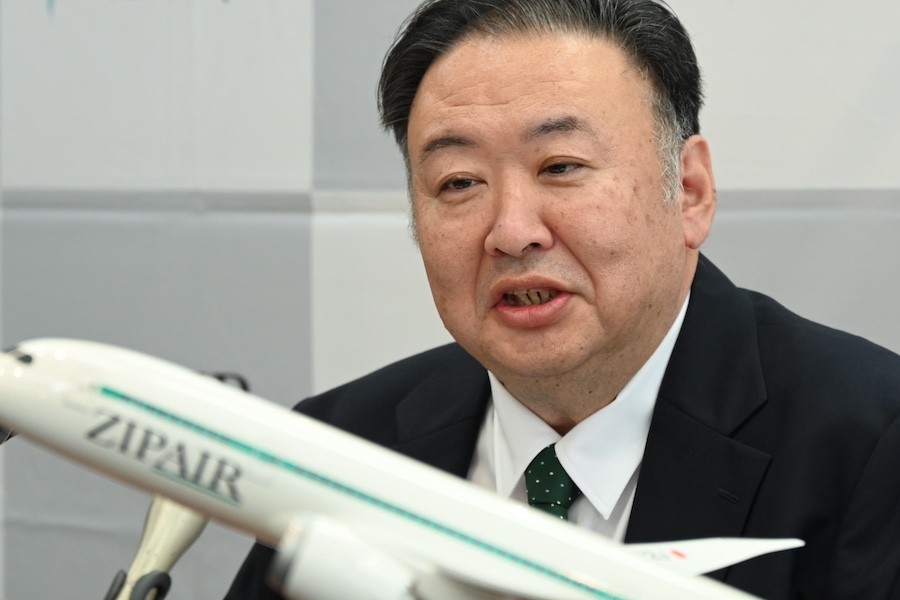
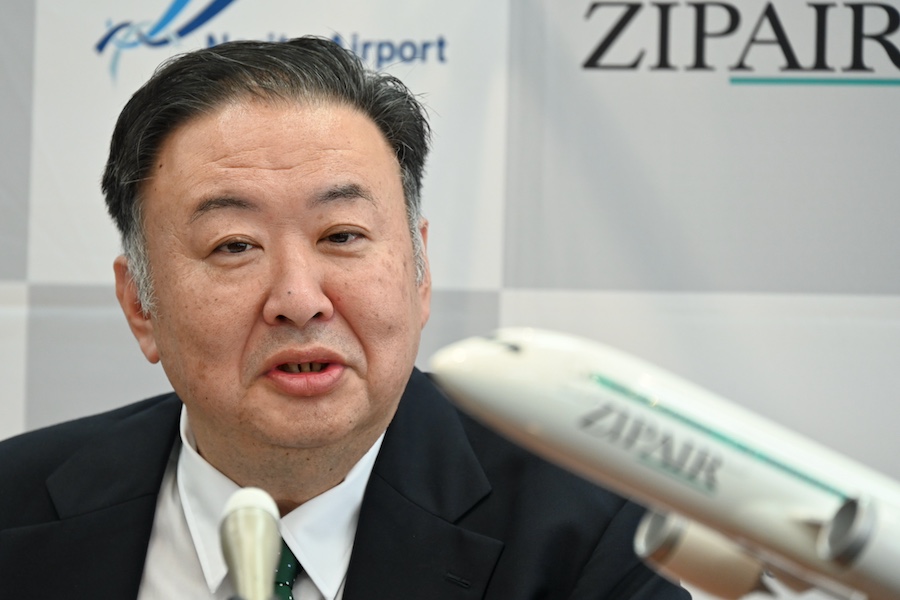
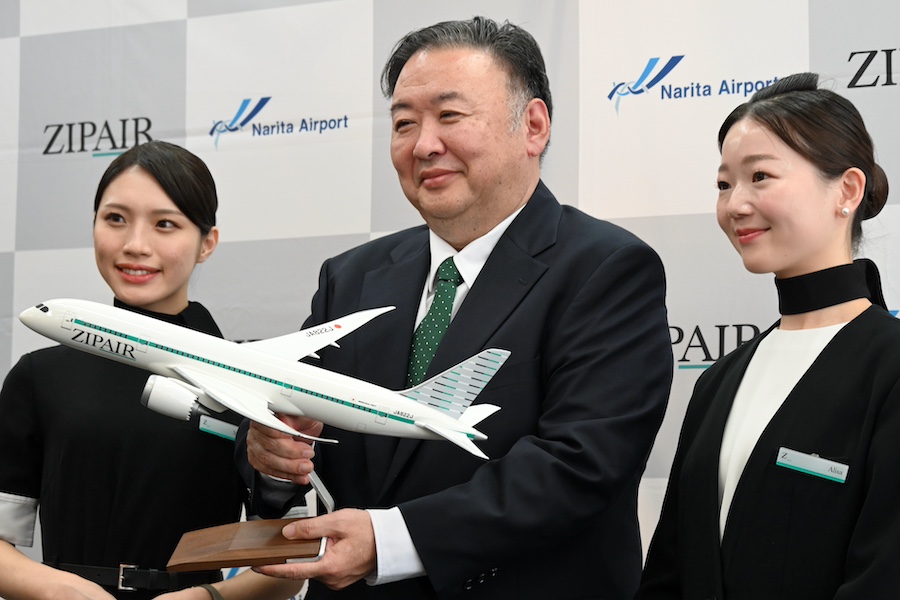
Yasuhiro Fukuda, President of ZIPAIR Tokyo, held an inaugural press conference at Narita Airport on April 8.
President Fukuda announced a policy of “inheriting the New Basic concept and evolving through technology,” indicating that he will carry on the “New Basic Airline” concept established by his predecessor, Shingo Nishida, while aiming for further growth by leveraging cutting-edge technologies such as AI.
President Fukuda joined Japan Airlines (JAL) in 1991. He has served as General Manager of the Route Business Planning Department Profit and Loss Management Group, General Manager of the Customer Strategy Department Strategy Group, General Manager of the Route Business Planning Department Business Marketing Strategy Group, and General Manager of the Strategy Promotion Department. He was later seconded to T.B.L., a preparatory company for ZIPAIR Tokyo established in 2018, where he served as Head of Planning and Marketing. He assumed the position of Representative Director and President of ZIPAIR Tokyo on April 1.
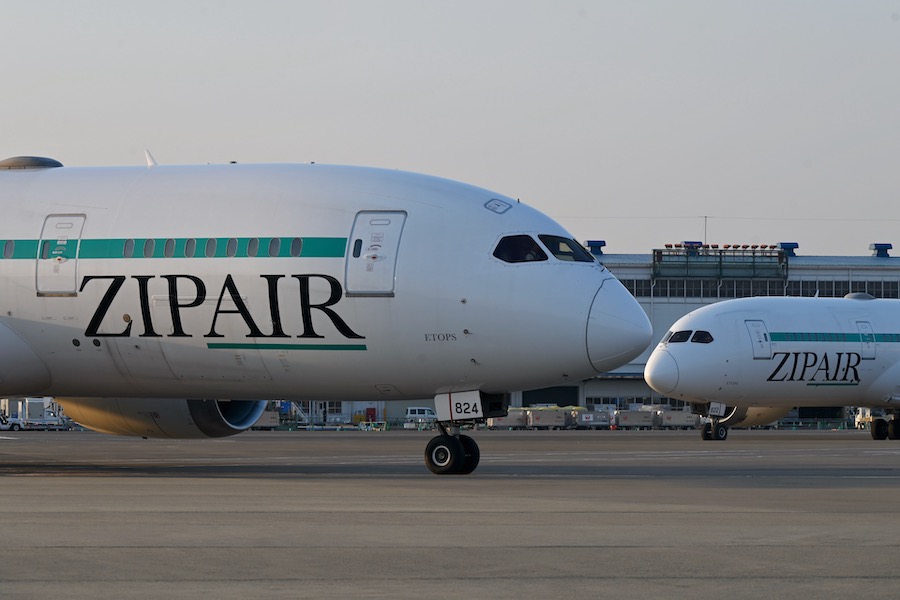
ZIPAIR Tokyo began operations in 2020 during the COVID-19 pandemic and has expanded its business scale under the concept of a “New Basic Airline,” offering simple and highly flexible services as its strength. The airline currently operates eight Boeing 787-8 aircraft, serving nine cities worldwide, and its cumulative number of passengers reached 4 million by the end of 2025.
Regarding the factors that have supported this growth, President Fukuda analyzes that it is “the attitude of flexibly delivering the most suitable options tailored to each individual customer.” He then emphasized the use of technology as a pillar to support future growth. By accelerating the introduction of the latest technologies, including AI, the airline aims not only to improve services but also to further enhance safety.
One symbolic initiative is the adoption of SpaceX’s satellite internet service “Starlink,” which has been progressively introduced since February. As of April 8, Starlink has been installed on 4 of the 8 aircraft in the fleet, and installation on the remaining aircraft will continue. President Fukuda stressed, “By providing an in-flight experience where customers can freely enjoy content on their own devices, we are working to create an environment in which flight time feels shorter.” The outlook is that Starlink will be available on all aircraft during the long holiday period starting at the end of April.
He also laid out a roadmap for the airline’s growth strategy. ZIPAIR Tokyo plans to introduce around ten Boeing 787-9 aircraft from fiscal 2027 onward, with the goal of doubling its business scale by the early 2030s. In the current fiscal year, the airline will add two new 787-8 aircraft, expanding its fleet to ten aircraft by the end of the fiscal year. President Fukuda stated, “In line with the fleet expansion, we will further broaden our route network and build a system that allows our services to be used to even more destinations,” indicating that the airline will actively operate not only scheduled flights but also charter flights in response to seasonal demand.
At present, ZIPAIR Tokyo operates from Tokyo/Narita to nine cities: Seoul/Incheon, Bangkok/Suvarnabhumi, Singapore, Houston, Los Angeles, San Francisco, San Jose, Vancouver, and Honolulu. The airline is also planning to launch a Kuala Lumpur route sometime in 2026.
Notice
This article was generated using automatic translation by GPT-4 API. The translation may not be accurate.