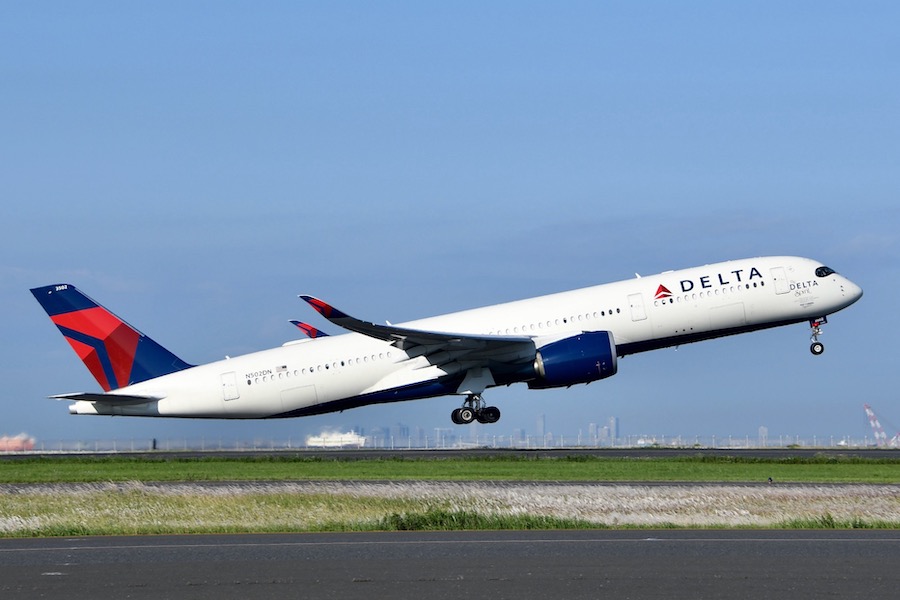
Delta Air Lines held its earnings briefing for the first quarter of fiscal year 2026 (January–March), revealing that a sharp spike in fuel costs against the backdrop of tensions in the Middle East is having a severe impact on its performance.
Total revenue for the first quarter was 14.2 billion US dollars, the highest ever for the same quarter and up 9.4% year-on-year. Pre-tax income was 530 million US dollars, and earnings per share were 0.64 US dollars, which fell within the company’s initial outlook.
Meanwhile, the average fuel cost was 2.62 US dollars per gallon, about 0.40 US dollars higher than assumed at the start of the first quarter. While utilization of the company’s own refinery has reduced costs by 0.06 US dollars per gallon, the rapid increase in fuel prices since March has squeezed profits.
Chief Executive Officer (CEO) Ed Bastian stated, “The surge in fuel prices triggered by the situation in the Middle East is unprecedented and has nearly doubled since the start of the year.” The airline projects its second-quarter fuel cost at around 4.30 US dollars per gallon, which means more than 2 billion US dollars in additional fuel expenses for the quarter compared to the beginning of the year. The company expects approximately 300 million US dollars in profit from its refinery operations.
In response to these conditions, Delta will cut capacity in the second quarter on flights that generate 15–20% less revenue than peak-time services, such as off-peak and late-night flights. The company’s projections assume fuel prices of 4–5 US dollars per gallon.
While keeping overall capacity roughly flat, Delta expects revenue growth in the 10% range. The airline plans to pass on 40–50% of the higher fuel costs through fares. As a result, it forecasts an operating margin of 6–8% and pre-tax income of 1 billion US dollars for the second quarter.
Bastian commented, “Looking back historically, high fuel prices have been the most powerful catalyst for industry transformation, separating winners from losers and forcing weaker players to rationalize, consolidate, or exit the market. I expect to see similarly large-scale structural reforms this time as well,” expressing the view that, over the medium to long term, surging fuel costs could actually work to Delta Air Lines’ advantage.
Notice
This article was generated using automatic translation by GPT-4 API. The translation may not be accurate.