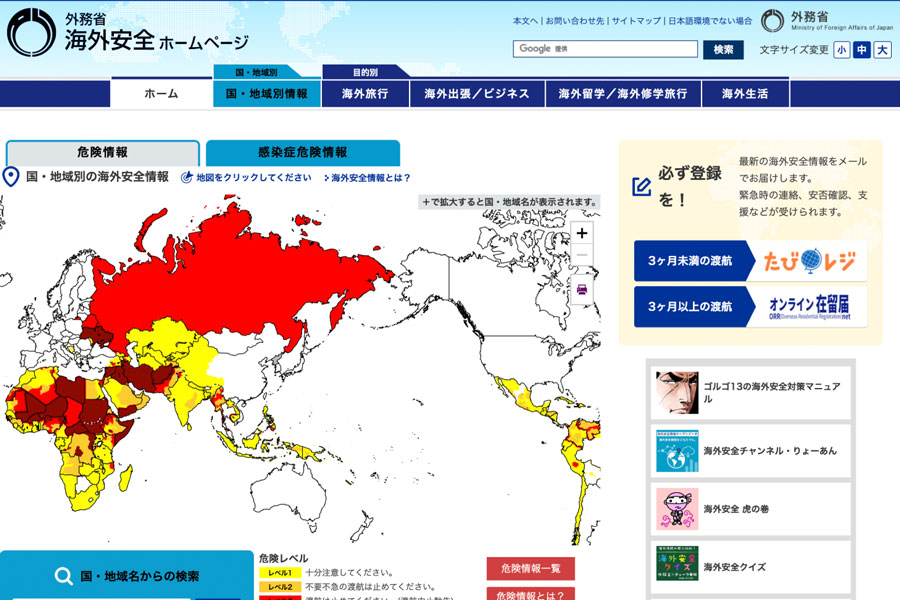
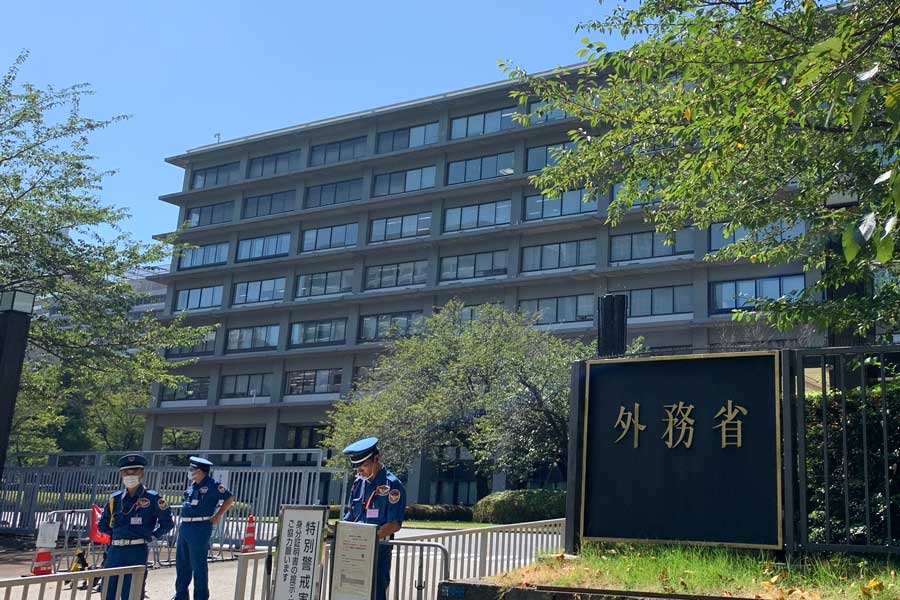
Japan’s Ministry of Foreign Affairs has lowered the danger level for certain areas near the border between Cambodia and Thailand.
For both countries, the areas between 30 and 50 kilometers from the border have been downgraded from Level 3 (recommendation to avoid all travel) to Level 2 (avoid non-essential travel). Areas within 30 kilometers of the border in both countries remain at Level 3.
Since July 2025, military clashes involving gunfire, shelling, and airstrikes between the armed forces of the two countries had occurred near the Cambodia–Thailand border. Although a ceasefire agreement was reached once on July 28 and a joint declaration toward the implementation of the ceasefire was signed on October 26, military clashes broke out again in December. The Thai military carried out multiple airstrikes even in areas more than 50 kilometers from the border, with some attacks reported in areas nearly 80 kilometers away from the border. The number of evacuees on the Cambodian side temporarily exceeded 600,000, but on December 27 the defense ministers of Cambodia and Thailand agreed to a ceasefire from noon that day, and as of June 6 the number of evacuees had decreased to about 29,000.
Although tensions have continued since the December ceasefire, there have been no large-scale military clashes for about six months, and the situation is more stable compared to the peak period. In light of this, both countries have downgraded the areas between 30 and 50 kilometers from the border. However, the withdrawal of heavy weapons from the border areas of both countries has not progressed, and the possibility of accidental clashes cannot be ruled out. For this reason, the Level 3 recommendation to avoid all travel continues to apply to areas within 30 kilometers of the border.
On the Cambodian side, the affected areas are the border regions of Preah Vihear Province, Oddar Meanchey Province, Banteay Meanchey Province, Pursat Province, Battambang Province, and Koh Kong Province. On the Thai side, the affected areas are Sisaket Province, Surin Province, Buriram Province, Ubon Ratchathani Province, Sa Kaeo Province, Chanthaburi Province, and Trat Province. Even away from the border, military-related facilities are under a high state of alert, and there is a possibility of being detained for taking photographs due to information controls by local authorities. The ministry therefore urges travelers to act with caution and to refrain from photographing military activities, military-related facilities, or weapons.
Regarding other regions in Thailand, attacks and bombings by Islamic armed groups advocating separatist independence occur frequently near the border with Malaysia in southern Thailand. As a result, certain parts of Narathiwat Province, Yala Province, Pattani Province, and Songkhla Province (Chana District, Thepha District, and Saba Yoi District) remain at Level 3, while other areas of Songkhla Province remain at Level 2. The rest of Cambodia continues to be designated as Level 1 (exercise normal caution).
The Ministry of Foreign Affairs also warns that in both countries there have been cases in which foreign nationals, lured by offers of lucrative jobs, were confined and forced to engage in illegal activities such as telephone fraud. The ministry calls on people traveling for work purposes to thoroughly verify information about their prospective workplaces before departure.
Notice
This article was generated using automatic translation by GPT-4 API. The translation may not be accurate.