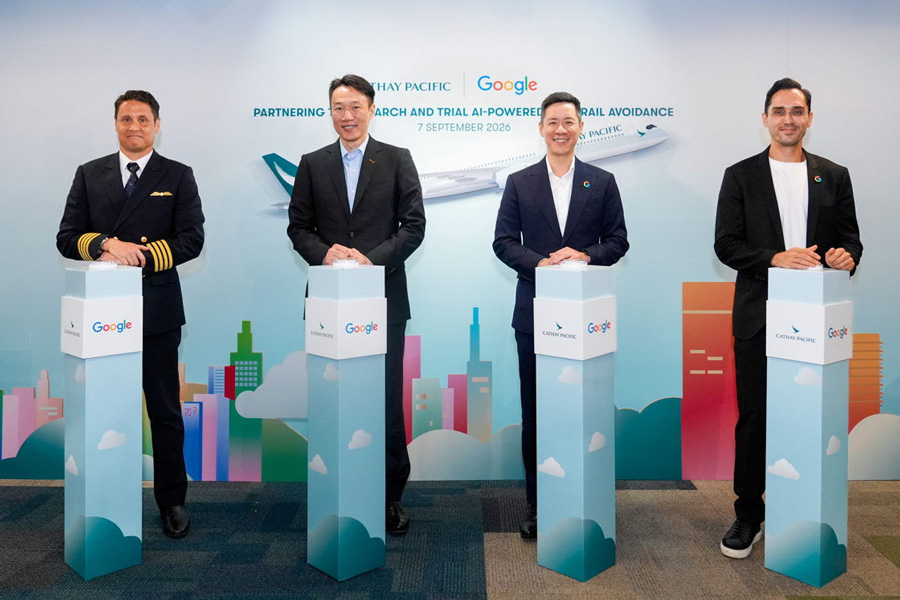
Cathay Pacific and Google have partnered on research into the climate impact of contrails.
Google’s contrail mitigation initiative combines AI-based predictive models, satellite-image detection, and weather data to forecast airspace where contrails are likely to form. Flight dispatchers and pilots can adjust altitude, much as they do to avoid turbulence. Cathay Pacific combines in-flight Wi-Fi with its in-house Electronic Flight Folder system to display Google’s forecast data and operational information in the cockpit.
The demonstration began in the latter half of 2025 and covered more than 100 flights. Of these, over 80 flew routes designed to avoid contrails, reducing the warming effect caused by contrails by approximately 40%, according to Google’s estimates. Not all flights took part due to airspace and aircraft weight restrictions.
The Hong Kong–Singapore route, one of the trial routes, passes through airspace where persistent contrails are likely to form. Initial analysis showed that minor altitude adjustments can prevent contrail formation, with measures on this route accounting for more than half of the demonstration’s overall climate impact.
Contrails are clouds that form when aircraft fly at high altitudes under cold and humid conditions. Most disappear quickly, but some persist and spread, trapping heat in the atmosphere. Previous research suggests that persistent contrails may account for around one-third of the aviation industry’s overall climate impact.
Cathay Pacific has become the first airline in the Asia-Pacific region to test Google’s AI-powered contrail mitigation technology, and the first case worldwide to examine contrail avoidance on ultra-long-haul routes. In the second phase, larger-scale demonstrations will be conducted on Asian and trans-Pacific routes, with Contrails.org, a nonprofit organization advancing scientific knowledge on contrail mitigation, also participating.