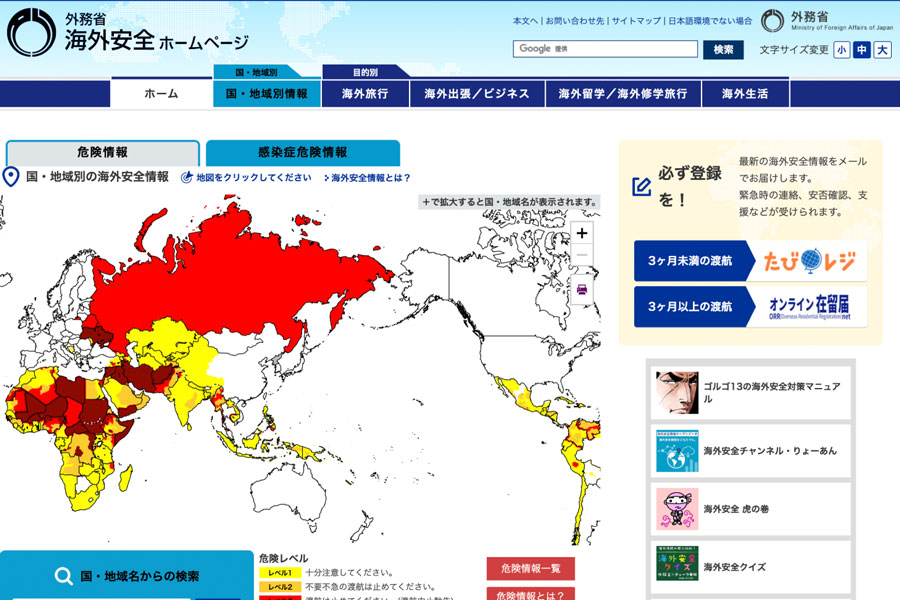
Japan’s Ministry of Foreign Affairs (MOFA) has issued a safety advisory for people traveling overseas from Japan during summer vacation and other holiday periods.
The ministry stresses the importance of confirming information in advance about the laws and customs of the destination, and of making sufficient preparations such as registering with the “Tabi-Regi” (Overseas Travel Registration) service and purchasing overseas travel insurance. By doing so, travelers can respond quickly to troubles and emergencies. MOFA notes that there have been cases of Japanese nationals becoming involved in ordinary crime, serious crime, natural disasters, and terrorist incidents while abroad, and calls on travelers to be very careful about gathering information and how they act at their destinations.
As preparations before departure, MOFA lists checking the “Travel Advice & Warning” and “Basic Data on Security Measures” for the destination country or region, registering with “Tabi-Regi”, taking out overseas travel insurance, and securing means of communication other than smartphones (such as sharing email addresses and travel itineraries/accommodation details with family members). It also notes that many countries and regions prohibit the bringing in of “electronic cigarettes” and “heated tobacco products”, and ban or regulate the import of “plants and animals”, “meat products”, “dairy products”, and “fruits”. Travelers are therefore urged to check restrictions on items they plan to carry into their destination country.
The ministry also calls for travelers to confirm in advance whether they need a visa and/or electronic travel authorization (such as ESTA). In particular, regarding electronic travel authorization, MOFA warns that online searches may display application agency sites that are not official government sites and that charge high handling fees, and advises applicants to always apply via the official government website of the destination country.
Due to a partial amendment of Japan’s Passport Act, passport issuance fees were reduced for applications submitted on or after July 1. As a result, a sharp increase in applications is expected from that date, and passport offices in each prefecture are expected to be crowded. Since it is highly likely that the number of applications will exceed the number of passports that can be produced, and it may take up to about one month for a passport to be issued after an application is accepted in Japan—compared with the usual period of around two weeks—MOFA is urging applicants to allow plenty of time when applying.
Even for countries that grant visa exemptions to Japanese nationals, there have been cases where travelers had to give up their trips because they discovered that their passports did not have enough remaining validity required by the destination country. MOFA recommends that those whose remaining passport validity is less than one year switch to a new passport. While the required remaining validity period varies depending on the country, length of stay, and purpose of entry, many countries require roughly three to six months or more.
As for precautions at the destination, MOFA lists behaviors to avoid becoming a victim of crime (such as not walking alone at night and not wearing expensive valuables), checking in advance whether photography or video recording is permitted (as even taking pictures in public places like airport lobbies can in some countries lead to being reported to and detained by security authorities), and making preparations for natural disasters.
Regarding terrorism, MOFA notes that in recent years not only Islamic extremists but also individuals influenced by far-right and far-left ideologies have carried out terrorist attacks. In addition, amid the situation in the Middle East, there have been terrorist incidents targeting Israeli interests and Jewish people. Travelers are urged to recognize that tourist attractions, event venues, restaurants, hotels, shopping malls, and public transportation systems are likely targets, and to stay alert to their surroundings.
Notice
This article was generated using automatic translation by GPT-4 API. The translation may not be accurate.