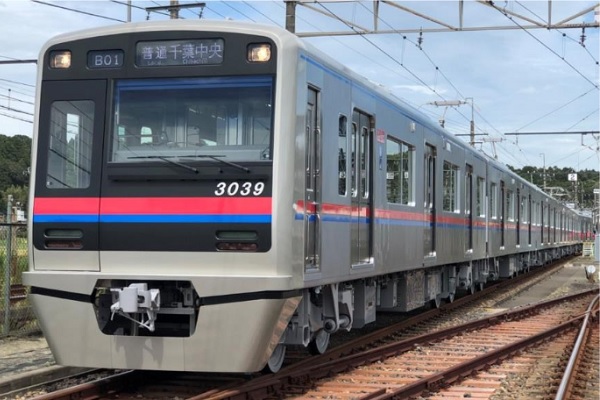
Keisei Electric Railway has applied to Japan’s Minister of Land, Infrastructure, Transport and Tourism for approval to revise its railway passenger fares. Excluding revisions resulting from changes in the consumption tax rate, this will be the first fare revision in 32 years, since 1995. Implementation is planned for March 2028.
The average revision rate will be 14.1%, while the revenue increase rate will be 12.2% (in both cases, when the railway station barrier-free charge is included in current fares). Breakdown: regular fares will increase by 14.3%, and commuter passes by 16.9%, while student passes will be reduced by 11.5% in consideration of the burden on household budgets, with their prices otherwise kept unchanged.
The base fare (up to 3 kilometers) will be 167 yen with an IC card and 170 yen with a paper ticket on the Keisei Main Line and other lines (currently 146 yen and 150 yen, respectively), and 229 yen with an IC card and 230 yen with a paper ticket on the Narita Airport Line (currently 210 yen for both).
Discount rates for commuter passes will be 36.3% for commuters (currently 34.5%) and 83.1% for students (currently 80.0%) on the Keisei Main Line and other lines. On the Narita Airport Line, they will be 30.8% for commuters (currently 30.2%) and 61.4% for students (currently 56.1%).
In addition, in light of its 2025 merger with Shin-Keisei Electric Railway, the company will integrate its fare systems. Currently, there are four fare systems: the Keisei Main Line and other lines (including the Oshiage, Kanamachi, Chiba, and Higashi-Narita lines), the Chihara Line, the Matsudo Line, and the Narita Airport Line. These will be reorganized into two systems: the Keisei Main Line and other lines (including the Chihara and Matsudo lines), and the Narita Airport Line. Fares on the Chihara and Matsudo lines will be set at the same level as those on the Keisei Main Line and other lines, and combined fare calculations (separate fare collection for each line) for journeys spanning the Keisei Main Line and other lines and the Chihara or Matsudo lines will be abolished. As setting fares for travel solely on the Matsudo Line at the same level as the Keisei Main Line and other lines would raise fares, the company plans to establish separate fares for travel within the Matsudo Line through notification, apart from the approved fares. As a result, fares for journeys exceeding 6 kilometers will be lower than on the Keisei Main Line and other lines.
The abolition of combined fare calculations will also result in lower fares on some sections. The fare between Chiharadai and Keisei-Funabashi stations will fall from the current 580 yen to 520 yen; between Shin-Tsudanuma and Chibadera stations, from 390 yen to 320 yen; and between Yabashira and Narita Airport stations, from 1,310 yen to 1,120 yen.
However, for reciprocal travel between Keisei-Takasago and Inba-Nihon-Idai stations on the Narita Airport Line, the fare system is the same as that of the Hokuso Line. Therefore, Keisei Electric Railway cannot revise it on its own or make it identical to that of the Keisei Main Line and other lines.
The railway station barrier-free charge currently being collected will be abolished in conjunction with this fare revision. Additional fares, including those between Keisei-Narita and Airport Terminal 2 or Narita Airport stations, will remain unchanged.
As a result, the fare between Keisei-Ueno and Narita Airport stations will be 1,230 yen via the Keisei Main Line (currently 1,050 yen) and 1,500 yen via the Narita Sky Access Line (currently 1,280 yen).
Keisei Electric Railway cited a decline in passengers due to the widespread adoption of telework, rising personnel, power, and other operating costs caused by inflation, and further cost increases due to the situation in the Middle East and other factors as reasons for the revision. Compared with fiscal 2020, electricity charges and material costs had risen by 33.3% and 21.9%, respectively, in fiscal 2025.
Notice
This article was generated using automatic translation by GPT-4 API. The translation may not be accurate.