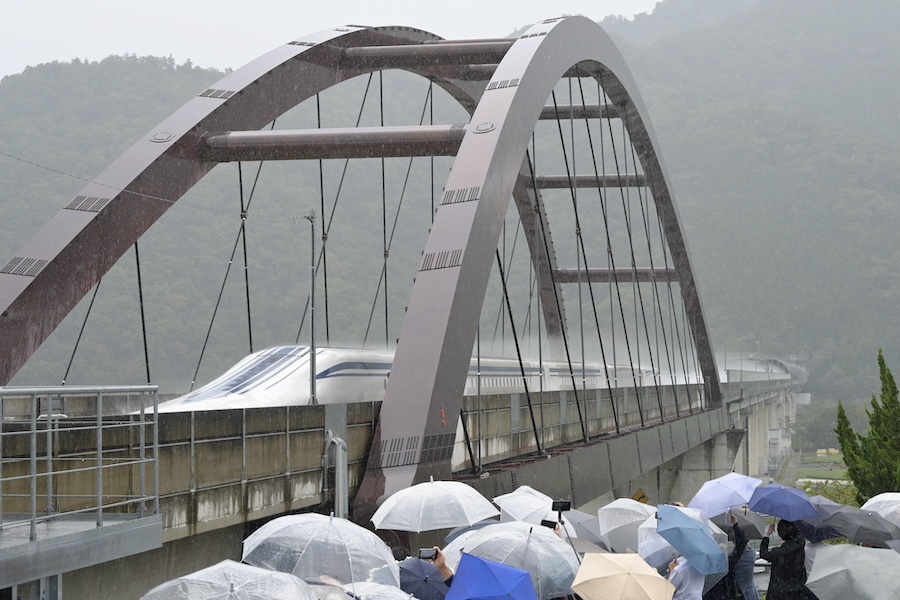
JR Central is continuing running tests of its improved L0 Series test train on the Yamanashi Maglev Line in preparation for the opening of the Chuo Shinkansen maglev line. On September 28, we experienced the world of 500 km/h—the planned top speed for commercial service—from inside the train.
The Chuo Shinkansen maglev line is planned to connect Shinagawa and Nagoya, a distance of 286 kilometers, in as little as 40 minutes, with a future extension to Osaka. Development of the superconducting maglev technology to be used on the line began more than 60 years ago, in 1962. Research has continued since before even the Tokaido Shinkansen opened, while running tests have been conducted in Yamanashi since 1997.
The 42.8-kilometer test section, formerly known as the “Yamanashi Maglev Test Line,” was renamed the “Yamanashi Maglev Line” in July, following the completion of technology development for commercial operations. The “Yamanashi Test Center” was also renamed the “Yamanashi Maglev Center.”
Hirotsune Shigeta, Senior Executive Officer and Deputy Head of JR Central’s Chuo Shinkansen Promotion Headquarters, emphasized that “the technology needed for commercial operations has been completed. We are ready to begin commercial service at any time.” Development on the Yamanashi Maglev Line is now focused on reducing costs, improving passenger comfort, and making maintenance work more efficient in anticipation of the start of service.
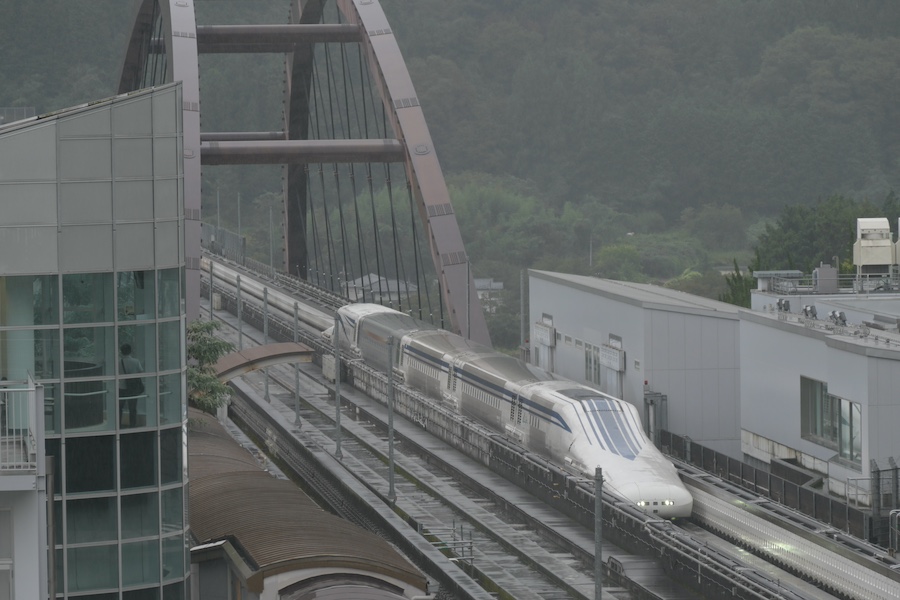
The “M10” train car ridden on this occasion is a test vehicle for that purpose. It is an intermediate car that further refines the existing improved L0 Series test train, and began running tests in July 2025.
The unpainted silver body features gold lines inspired by light streaming past at high speed. Its surface uses “riblet film,” which has sharkskin-like grooves, and the shape around the bogies has also been redesigned, reducing aerodynamic resistance by around 1% for a 16-car train. The car is also designed specifically for high-temperature superconducting magnets, which can maintain superconductivity at higher temperatures than conventional magnets. By eliminating the need for liquid helium and piping within the magnets, the design simplifies the structure and helps reduce costs.
Experiencing 500 km/h
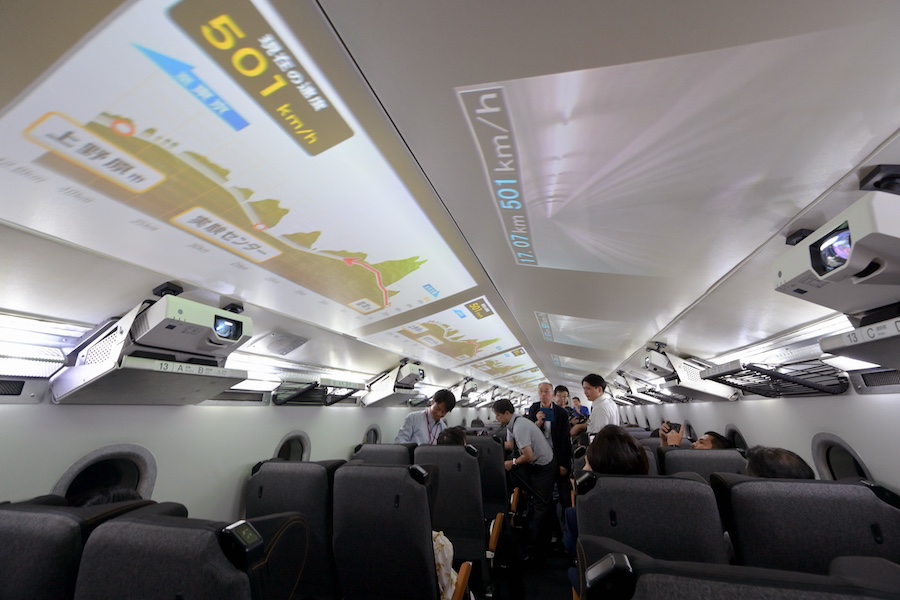
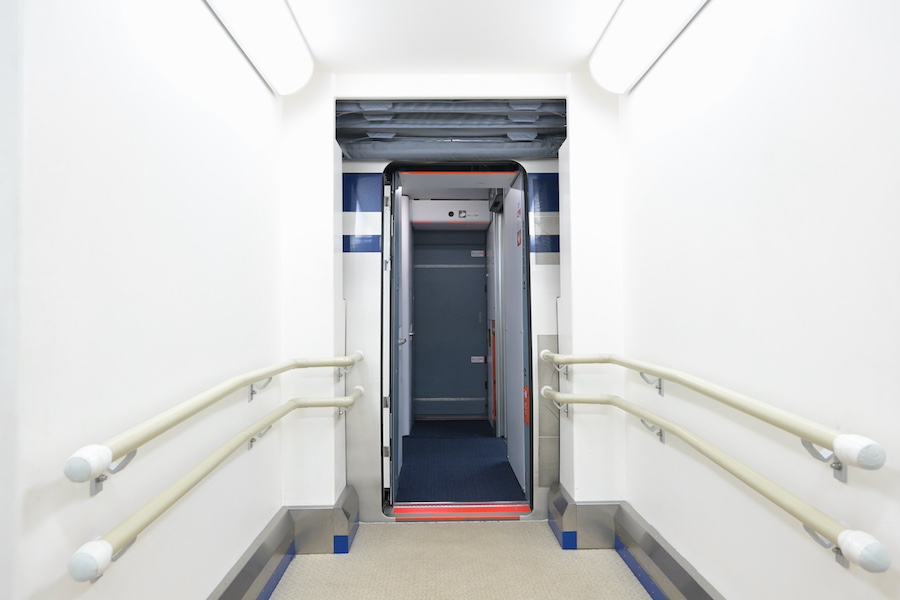
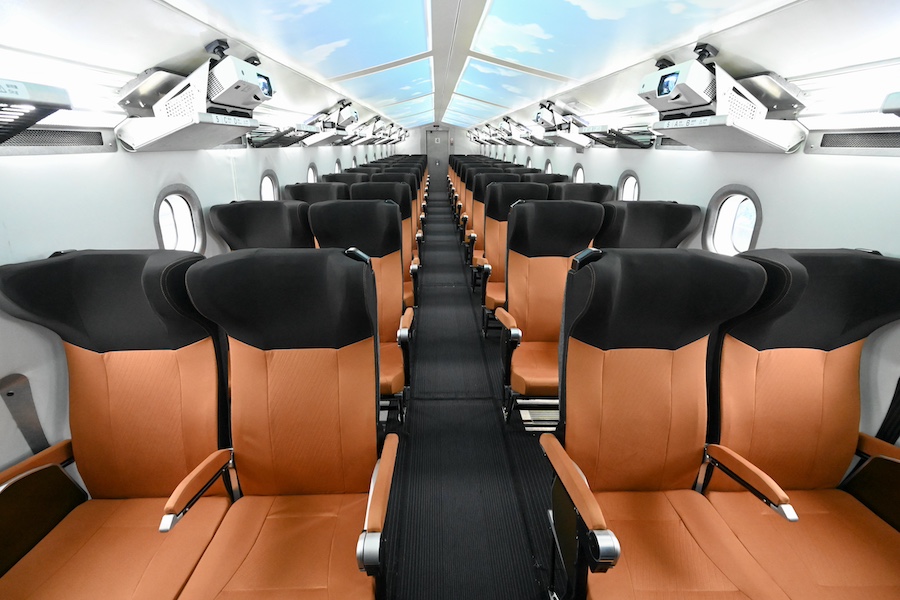
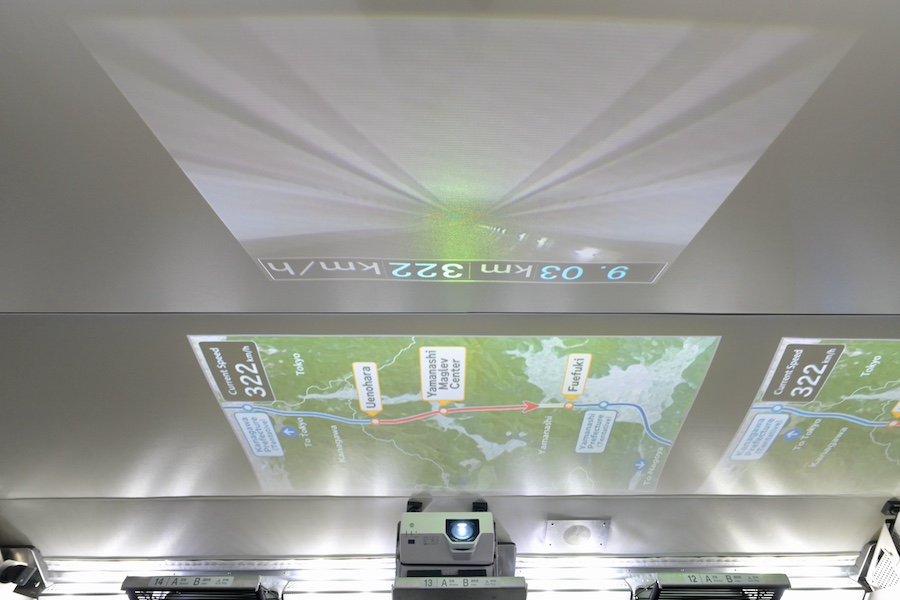
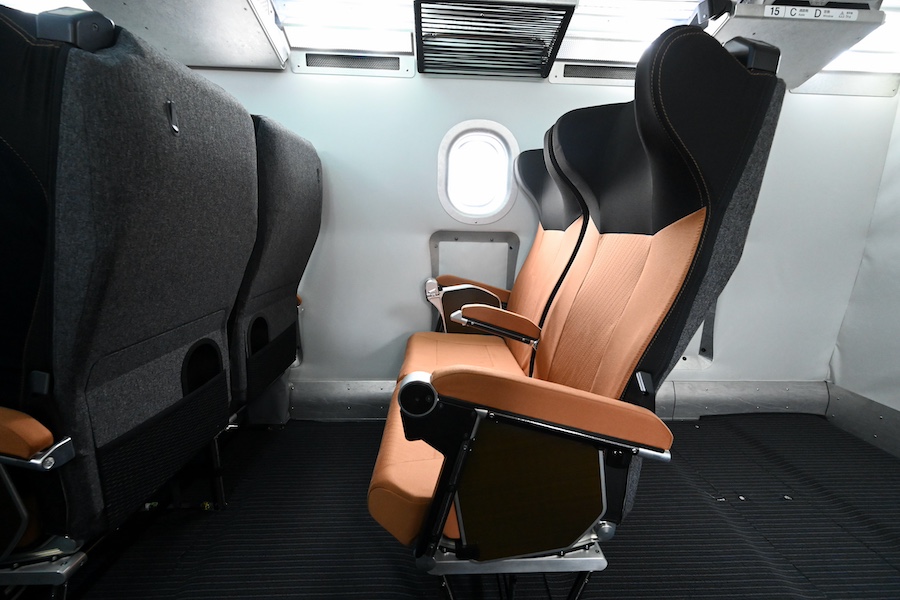
After passing through a gate reminiscent of an airport boarding gate, we entered the train and headed to Car No. 4, which included the M10. Orange seats are arranged in a 2+2 configuration in the predominantly white cabin. Its atmosphere differs from that of the conventional cars with cool-colored seats, creating a somewhat warmer space. A projector is installed on the ceiling, displaying forward-view footage as well as the train’s current position and speed while running. (For a report on a ride aboard the previous improved L0 Series, click here.)
Maglev trains are associated with levitated travel, but the train does not begin floating the instant it departs. At low speeds, it runs on rubber-tired wheels; once it reaches a certain speed, the wheels retract and the train levitates. It then accelerates through the interaction between propulsion coils on the ground and superconducting magnets aboard the train.
Because it runs on wheels immediately after departure, the running noise and fine vibrations transmitted through the floor feel somewhat similar to those of a Shinkansen. The train levitated when it reached 157 km/h, but there was no distinct sensation that it had “lifted off.” Instead, it became apparent that the train had levitated as the noise and vibrations from the wheels suddenly diminished.
The speed display projected onto the ceiling passed 300 km/h, then 400 km/h, and the numbers continued to climb. On the Tokaido Shinkansen, this would already be well beyond top speed, but the maglev continued accelerating. The rushing sound of the wind also gradually grew louder.
About 1 minute and 51 seconds after levitation, after traveling approximately 10.5 kilometers, an automated announcement said, “The train has reached 500 km/h.”
The train ran at its top speed for around one minute. There was no major swaying that would make passengers brace themselves, and even walking through the cabin did not feel unstable. If the speed were not displayed on the ceiling, it would be easy to forget that the train was traveling at 500 km/h.
Rather, it was during deceleration that the sensation of floating became more apparent. When the train slowed to around 136 km/h and returned to wheel-based running, a noticeable jolt was felt. It was slight compared with an aircraft landing, but there was also a sensation of the body pitching forward. At that moment alone, it seemed preferable to remain seated.
“The Technology Is Complete”; Opening Day Comes Next
The Chuo Shinkansen maglev line has a role beyond simply linking Tokyo and Nagoya in a short time. A major objective set out by JR Central is to create a second high-speed rail route alongside the Tokaido Shinkansen, providing redundancy for this vital transportation corridor.
In addition to preparing for future large-scale renovations of the Tokaido Shinkansen, which has been in operation for more than 60 years, the goal is to maintain transportation links between Japan’s three major metropolitan areas of Tokyo, Nagoya, and Osaka during major disasters such as a Nankai Trough megathrust earthquake.
While technology development has matured to the point where commercial operations could begin immediately, construction of the revenue line is still incomplete, and no specific opening date has been announced. According to JR Central, construction contracts have been signed for more than 90% of the Shinagawa–Nagoya section, while land acquisition has progressed to approximately 85%. The situation surrounding the Shizuoka construction section, a major focus of the project, has also begun to move forward, with efforts currently underway toward the start of construction.
The vision of connecting Shinagawa and Nagoya in just 40 minutes has long been described as “the railway of the future.” Yet, as Shigeta says, the technology has already reached the point at which commercial service can begin at any time. Sitting aboard a train racing along at 500 km/h, the description “a vehicle of the future” no longer seemed quite fitting.
Notice
This article was generated using automatic translation by GPT-4 API. The translation may not be accurate.