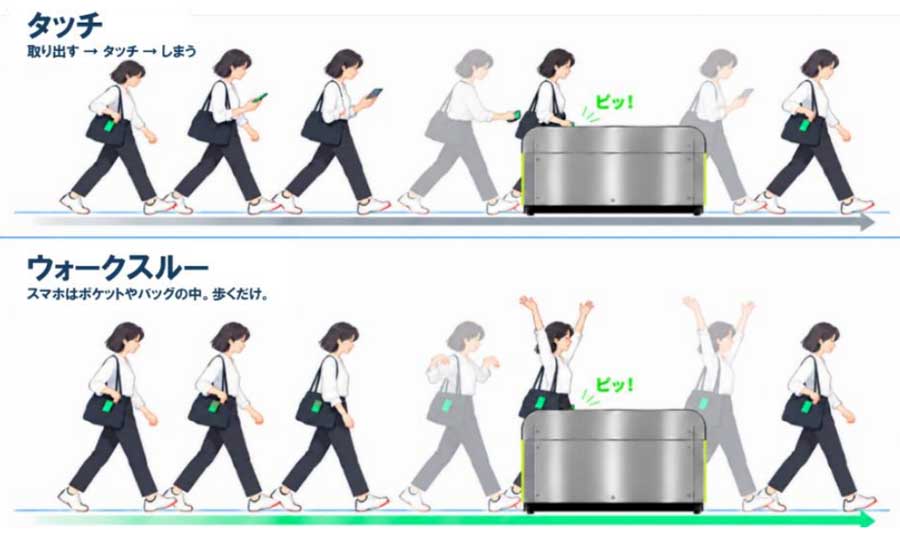
JR East has announced that it will fully introduce “walk-through ticket gates,” which allow passengers to pass through ticket gates without taking out their smartphones, at 40 stations in the Tokyo metropolitan area in spring 2028.
The stations will include all stations on Tokyo’s Yamanote Line, all stations at Narita Airport, all Tokyo Monorail stations at Haneda Airport, and Monorail Hamamatsucho Station, for a total of 40 stations. One walk-through gate lane each for entry and exit will be installed at every ticket gate. Passengers using Mobile Suica on compatible smartphones will no longer need to take out and tap their phones, allowing them to pass through ticket gates at the same speed as with conventional tap-based use. This will also make it easier for passengers carrying large luggage or using strollers or wheelchairs to pass through without having to take out their phones.
Passengers will be able to continue using their current Mobile Suica, choosing either “Touch & Go” or “Walk-Through.” Traveling beyond a commuter pass’s valid area and using the stored-value balance will also remain possible as before. Passengers boarding at a station equipped with walk-through gates and getting off at a station without them will need to tap their phones when exiting. The system uses Ultra-Wide Band (UWB) communication technology.
The development partners are Sony, which is developing and manufacturing walk-through-compatible reader/writers; FeliCa Networks, which is developing smartphone security software; and JR East Mechatronics, which is developing and installing the ticket gates.
Before the full rollout, a trial program will be conducted from April 10, 2027, through February 29, 2028. The trial will verify the accuracy of ticket gate processing and performance in congested environments. It will be carried out at 14 stations: five in the Greater Shinagawa area—Hamamatsucho, Tamachi, Takanawa Gateway, Shinagawa, and Oimachi—and nine major Tokyo metropolitan area terminal stations—Tokyo, Ueno, Shinjuku, Shibuya, Ikebukuro, Akabane, Kita-Senju, Nakano, and Osaki. Approximately 400 monitor participants who hold commuter passes valid between the trial stations will be able to use the walk-through system for entry and exit within their commuter pass areas. Smartphones equipped with an application developed for the trial in cooperation with Sharp will be loaned to participants. Details of the trial and how to apply as a monitor participant will be announced separately.
Based on the results of the trial, JR East plans to gradually expand the range of use cases and eligible users. The company also intends to extend the system to stations across both the Tokyo metropolitan area and regional areas via Shinkansen and conventional railway lines, with the aim of introducing it at all stations that currently have ticket gates by the end of fiscal 2031.
Furthermore, by the mid-2030s, JR East plans to introduce “Smartphone Ticket Gates” (tentative name), using GPS location technology to create a seamless travel experience without a distinction between inside and outside stations at all stations.
Notice
This article was generated using automatic translation by GPT-4 API. The translation may not be accurate.