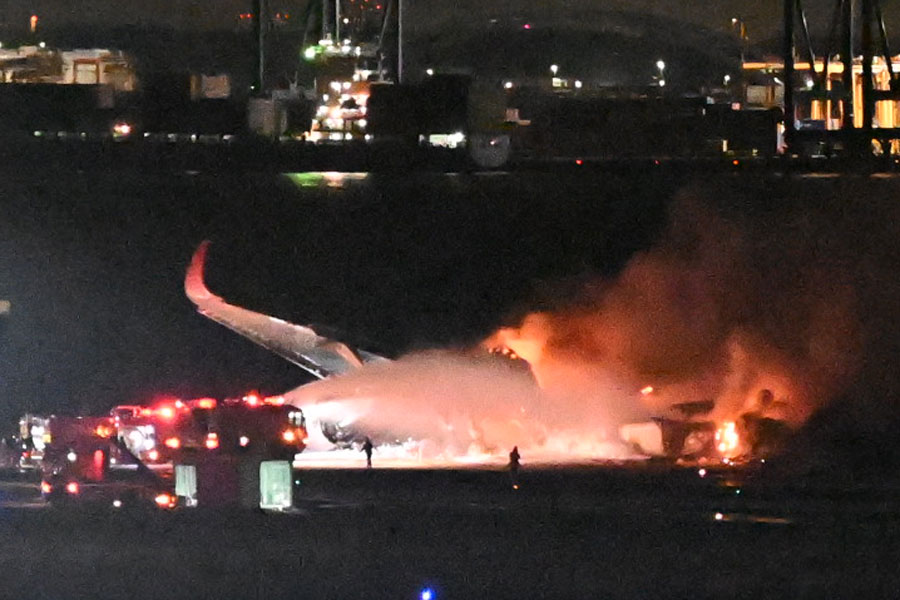
The Japan Transport Safety Board (JTSB) has revealed that the transmission range of the megaphones installed on the Japan Airlines (JAL) aircraft involved in the collision with a Japan Coast Guard aircraft at Tokyo’s Haneda Airport on January 2, 2024, was found to be insufficient.
The JAL aircraft was equipped with megaphones for use inside the cabin and after evacuation, in order to facilitate communication among cabin crew and to provide instructions and guidance to passengers in emergencies and other critical situations. Because the public address (PA) system did not operate at the time of the accident, some flight attendants used the megaphones, but the accident investigation found that some stopped using them because they felt they were ineffective.
As part of an analysis on mitigating damage, the JTSB and Airbus conducted tests on megaphones of the same model, and found that the range over which instructions could be transmitted was inadequate.
In the verification, a flight attendant at the very front of the aircraft near the L1 door gave evacuation commands toward the rear of the cabin. Cabin crew positioned at each exit were to relay the instructions further aft using megaphones of the same model once they could hear the commands. The test showed that the instructions could be heard in the vicinity of the L2 and R2 doors, but were difficult to hear around the L3 and R3 doors, and could not be heard around the L4 and R3 doors.
The distance between the speaker’s mouth and the megaphone microphone was set to 0 centimeters, and the sound level was measured using six collection microphones installed at different locations. Evaluations were then carried out by flight attendants positioned throughout the cabin and by approximately the same number of investigators acting as passengers in various parts of the cabin.
For the verification, conditions were set to simulate the noise environment at the time of the emergency evacuation, including the right engine continuing to run, cabin crew performing panic control to calm passengers, and passengers themselves shouting. Tests were conducted while changing conditions such as the speaking position of cabin crew and whether megaphones were used or not.
The JTSB determined that, because megaphones of the same model are also installed on aircraft other than the Airbus A350-900 type used in the accident, there is a possibility that similar situations could occur on aircraft other than the Airbus A350-900. Concluding that countermeasures need to be considered, the Board has provided this information to the Civil Aviation Bureau of Japan’s Ministry of Land, Infrastructure, Transport and Tourism.
Notice
This article was generated using automatic translation by GPT-4 API. The translation may not be accurate.