East Japan Railway Company (JR East) and KDDI have successfully conducted a demonstration to expand 5G (millimeter-wave) coverage inside Yamanote Line train cars. This is the first initiative in Japan to draw millimeter waves from outdoor base stations into train cars and re-radiate them inside.
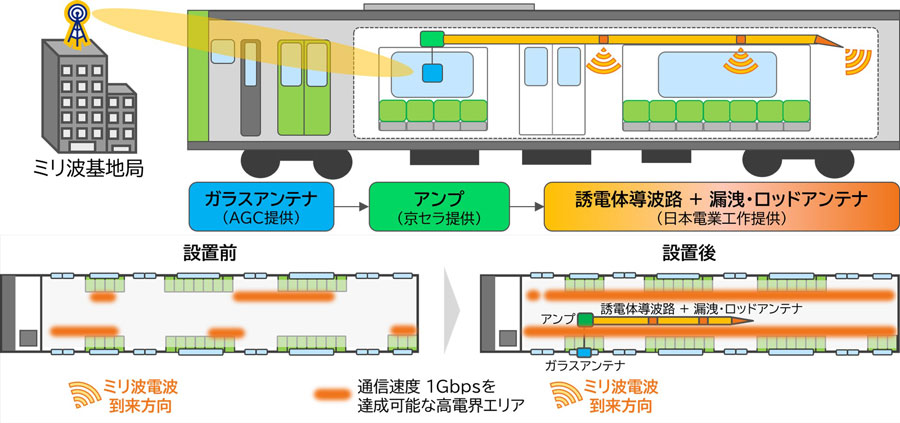
The demonstration was carried out using Yamanote Line train cars stationed at JR East’s Tokyo General Rolling Stock Center between March 3 and April 15. Radio waves transmitted from millimeter-wave base stations along the tracks were received by glass antennas installed on the train windows, amplified by an amp, and then transmitted and re-radiated inside the cars using dielectric waveguides. This configuration enabled the companies to overcome the issue of millimeter-wave shielding by the train’s metal structure and confirmed that the coverage area capable of 1 Gbps communication speeds improved from about 40% to about 97% of the entire train car.
Although the 28 GHz millimeter-wave band can provide high-speed, large-capacity communications, its strong directivity makes it highly susceptible to obstacles, which has traditionally made it difficult to provide coverage inside railway cars that use a lot of metal structures. AGC (glass antennas), Nihon Dengyo Kosaku (dielectric waveguides, leaky antennas, and rod antennas), and Kyocera (amps) cooperated in this demonstration.
Based on the knowledge obtained from this demonstration, the two companies intend to promote expanded use of millimeter waves in various indoor environments and drive digital transformation (DX) in railway operations.
Notice
This article was generated using automatic translation by GPT-4 API. The translation may not be accurate.